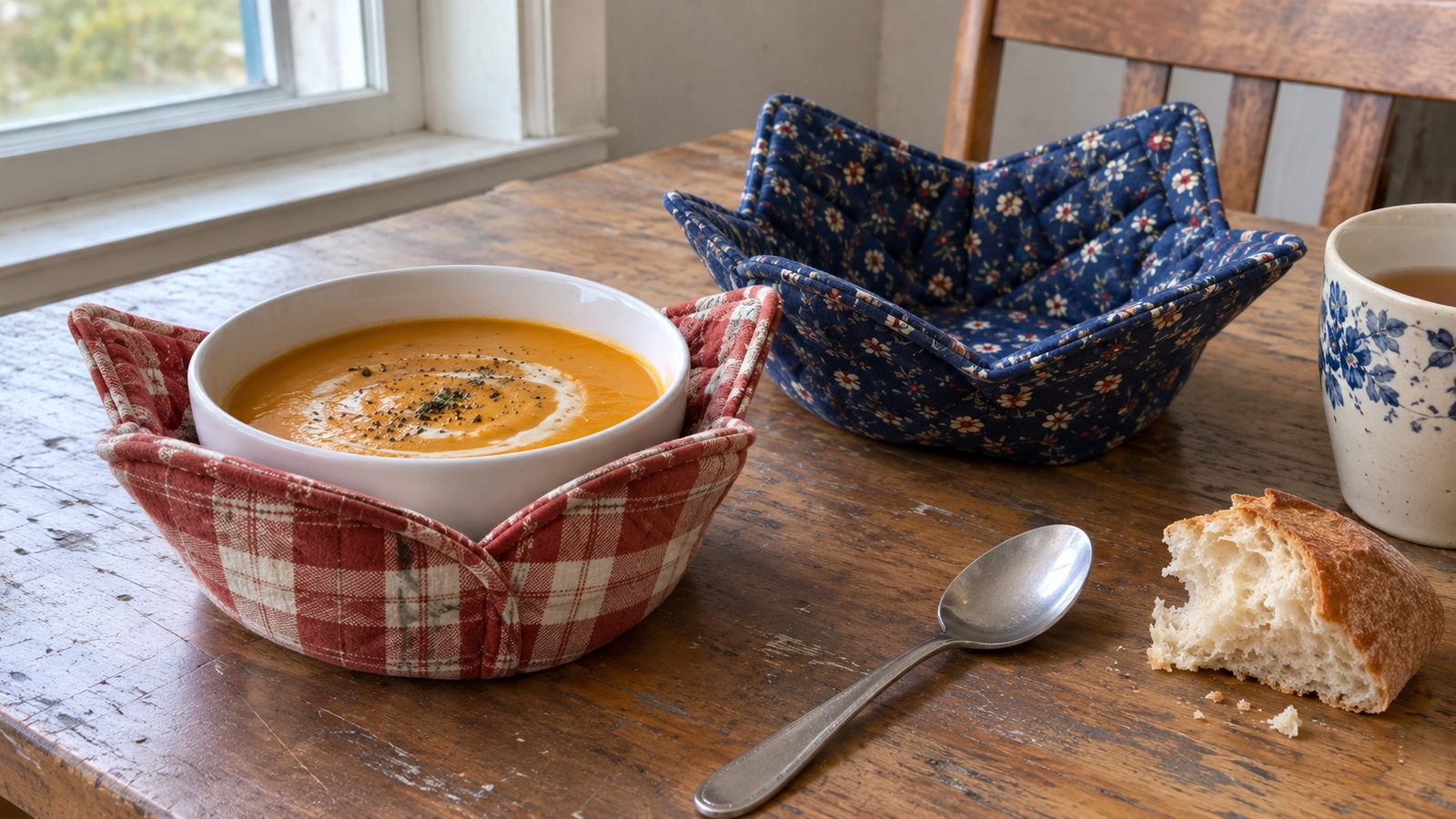
A bowl cozy is a padded fabric bowl that holds your soup bowl, so you can lift it out of the microwave without a towel or a burned thumb. Two 10 inch squares of cotton, two squares of cotton batting, four darts, turned and topstitched. It fits a standard cereal or soup bowl and sits flat on the table while you eat.
The first one takes about 40 minutes. After that, 20 minutes each, and I never make fewer than four at a time. Beginner level: straight seams and eight short dart lines.
The one thing that makes it come out well is also what makes it safe. Every part is 100% cotton. Fabric, batting, thread. One polyester shortcut and it can scorch in the microwave.
What you’ll need
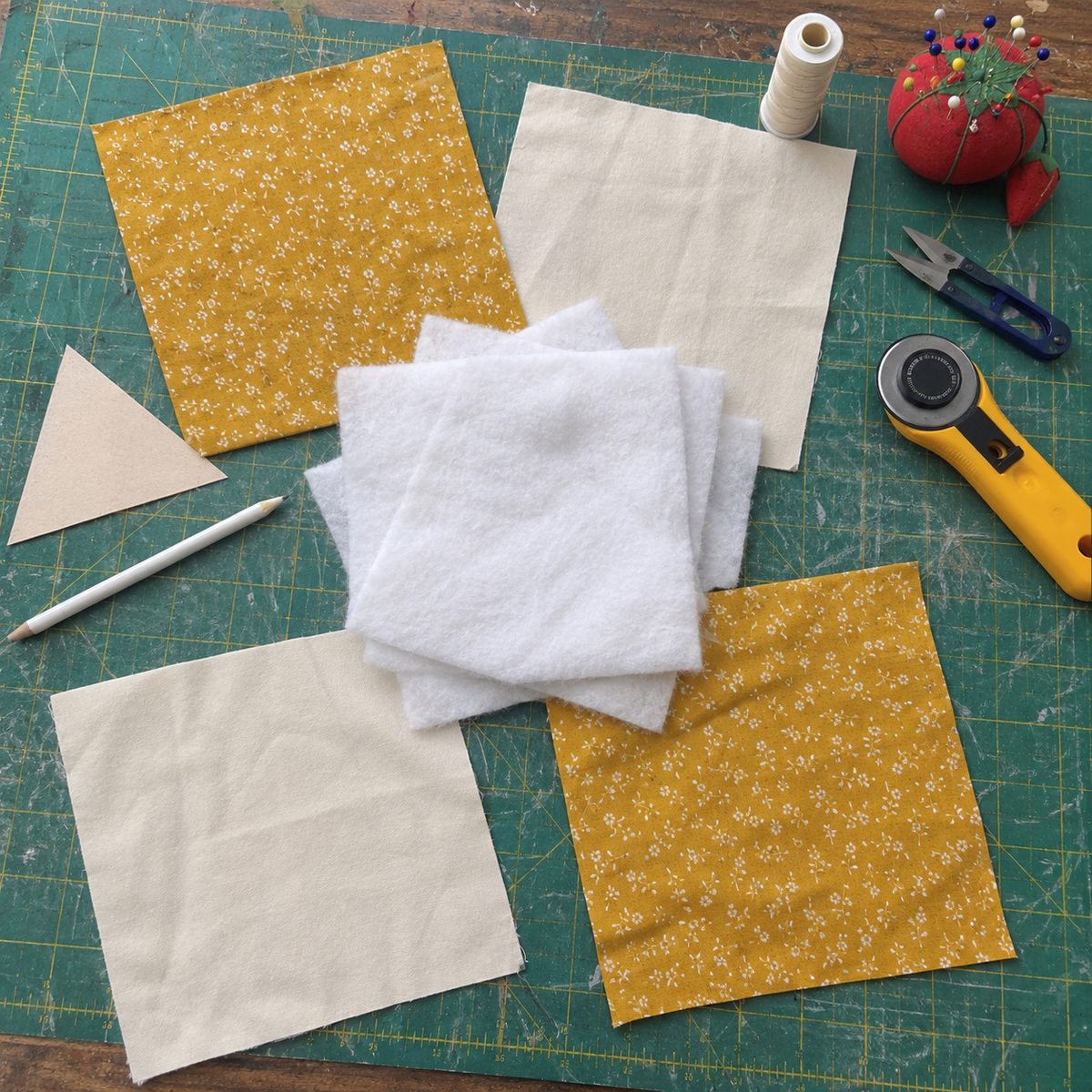
- Two fat quarters (18 by 22 inches) of 100% cotton quilting fabric, one for the outside and one for the lining. Each fat quarter cuts two 10 inch squares, so the pair makes two cozies.
- 1/3 yard of 100% cotton batting made for microwave use (Pellon Wrap-N-Zap, 45 inches wide), which cuts four 10 inch squares for two cozies.
- One spool of 100% cotton thread, 50 weight, in a color that disappears on both fabrics
- Universal or quilting machine needle, 90/14
- Rotary cutter, ruler and mat
- Chalk pencil or water-soluble marker, and a scrap of cardstock for a dart template
- Pins or clips, and a chopstick or point turner
- Walking foot, optional but worth it
| Piece | Cut size | Qty |
|---|---|---|
| Outer fabric (standard soup bowl cozy) | 10 by 10 inches | 1 |
| Lining fabric (standard) | 10 by 10 inches | 1 |
| Cotton batting (standard) | 10 by 10 inches | 2 |
| Small cozy for a ramekin, fabric and batting | 8 by 8 inches | 4 |
| Large cozy for a pasta bowl, fabric and batting | 12 by 12 inches | 4 |
Quantities are per cozy. The standard size uses a 1 by 2 inch dart at each corner and finishes about 7 inches across the base and 2 1/2 inches tall. Dart sizes for the other two are under variations.
Fabric, batting, thread, and prep
Read the bolt end first. You want 100% cotton, and quilting cotton or cotton flannel are both right. Skip poly-cotton broadcloth, which looks like quilting cotton and is usually 65% polyester. Skip metallic ink, which rules out most gold snowflake Christmas prints, and skip glitter. A scrap I cannot identify goes in the pile for quilted pot holders, which never see the microwave.
The batting is where people get in trouble. Pellon Wrap-N-Zap cotton batting is the one made for this job: needle-punched 100% cotton with no scrim and no glue, and Pellon itself says never to run it in the microwave without food inside. Warm & Natural is also cotton, but it is punched through a thin polypropylene scrim, so I keep it for quilts. Fusible batting is out because the fusible is a glue, and so is polyester batting of any kind. My rundown of what batting is and how the types differ covers the rest. No basting spray either.
Thread trips up more people than batting. All-purpose thread is polyester or cotton-wrapped polyester, and either one can melt into a hard brown bead where the needle holes concentrate the heat. Buy 100% cotton, 50 weight. It is a little weaker than polyester, so sew the seams at 2.5 and do not tug the fabric through. Use a 90/14 needle for four layers. This guide to needle sizes for cotton explains why an 80/12 will skip here.
Prewash the fabric hot and dry it hot, since a cozy gets washed often. Do not prewash the batting. It shrinks about 3% in the first wash, which pulls the quilting into a soft crinkle and tightens the whole cozy. Press the fabric with plain spray starch so the squares cut true.
Cut everything, then make the dart template. On cardstock, draw a right angle, mark 2 inches along one leg and 1 inch along the other, join the marks, and cut out the long thin triangle. Tracing it eight times beats measuring eight times. If you are cutting for several kitchen sewing projects in one sitting, cut the cozy squares first while the starch is fresh.
Quilt the squares
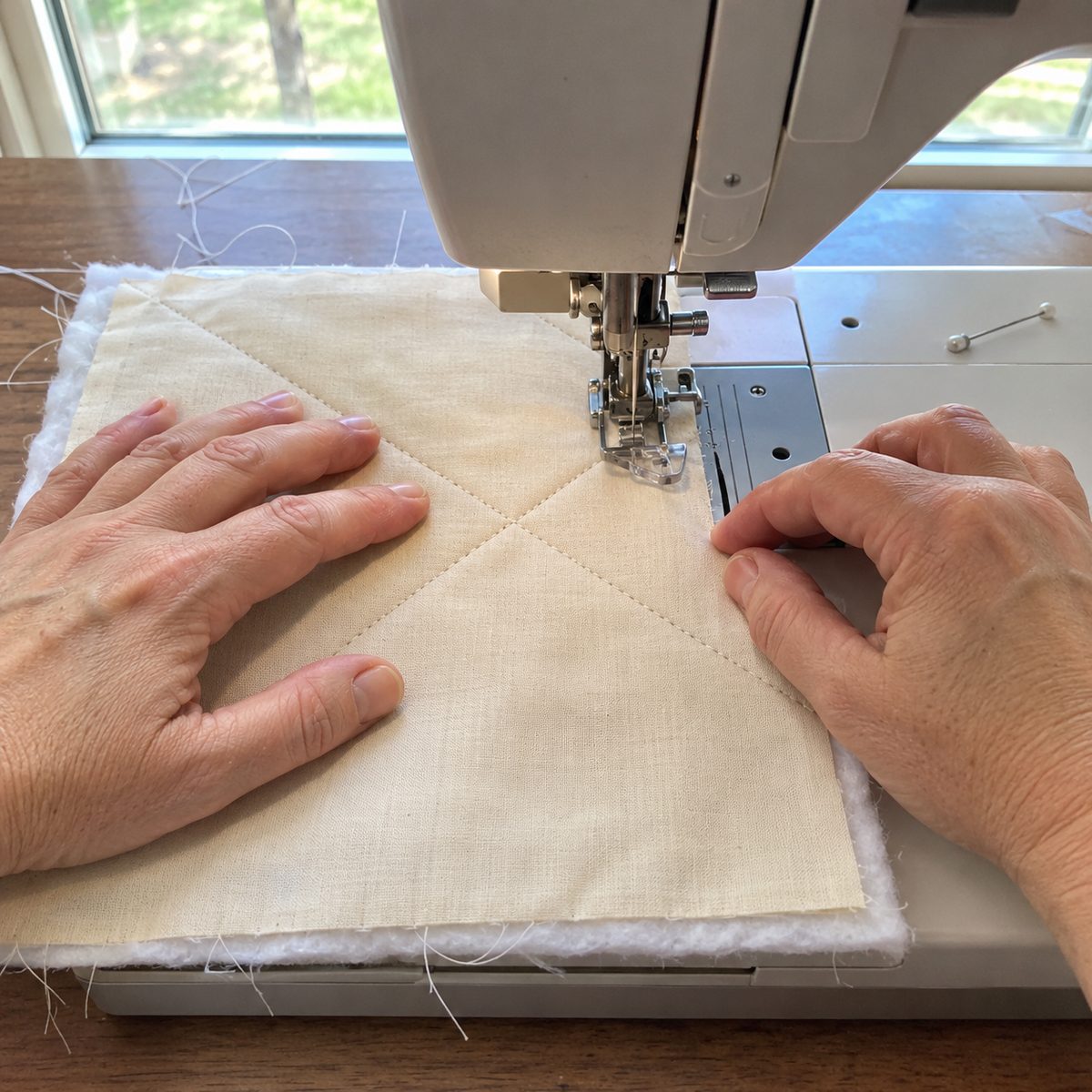
Each fabric square gets its own batting square and a quilted X. The X stops the batting from shifting and bunching in the wash.
- Lay one batting square on the table and the outer fabric square on top, right side up, edges matched. Pin in the center of each side. Repeat for the lining.
- Walking foot on, stitch length 3.0. Sew from one corner diagonally to the opposite corner, edge to edge, no backstitching. Then sew the other diagonal. You should have a flat X with no pleats where the lines cross.
- Check that the fabric still covers the batting on all four sides. If a layer crept, square the piece down to 9 3/4 inches, and trim the second piece to match or the darts will not line up later.
- Press each quilted square from the fabric side. It should lie flat with the edges even all the way around.
Sew the corner darts
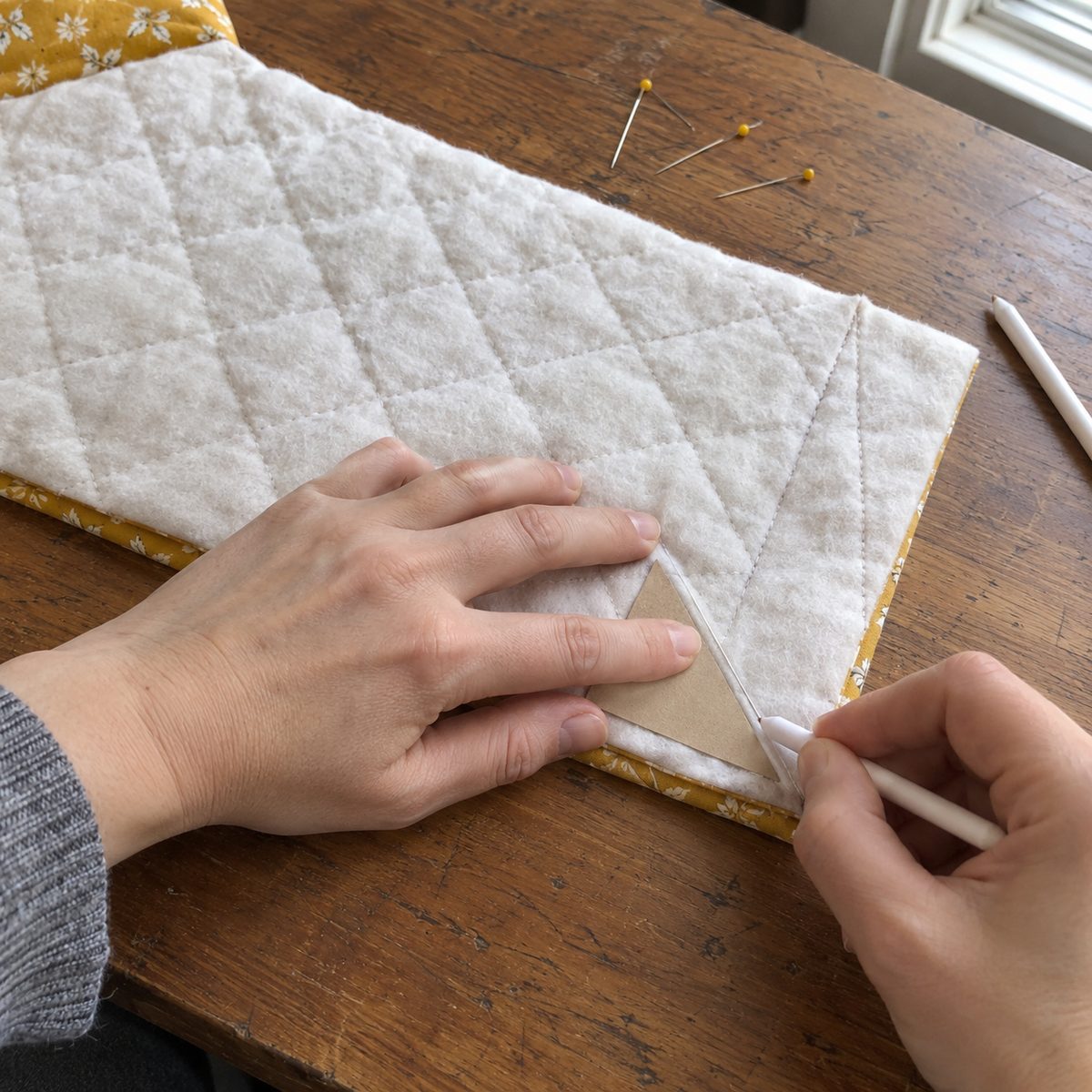
Four darts per piece turn the flat square into a shallow dish. They are sewn with the fabric folded in on itself, so the dart allowance ends up on the batting side.
- Fold the quilted outer square in half, fabric sides together, batting out. Lay the template at one end of the fold with the 2 inch leg on the fold and the 1 inch leg on the raw end, and trace the long diagonal edge. The line starts 1 inch above the fold at the raw end and runs down to the fold 2 inches in. Trace the matching line at the other end.
- Stitch length 2.5. Sew each line from the raw edge to exactly on the fold, backstitching at both ends. Ending on the fold is what gives the corner a smooth curve instead of a dimple.
- Unfold, then refold the other way so the two undarted corners sit on the new fold. Mark and sew two more darts the same way. All four dart points should be the same distance from their corner.
- Trim each dart allowance to 3/8 inch and finger press it to one side. Repeat on the lining square. Side by side, the two pieces should look like identical shallow dishes, batting side out.
Join the two layers
Now the two dishes go together, fabric to fabric, with the darts nested at each corner. Nesting the darts in opposite directions is the detail most beginner cozies miss, and it is the difference between lumpy corners and smooth ones.
- Set the outer piece fabric side up and drop the lining into it fabric side down. Match the four corners so dart seam meets dart seam.
- At each corner, fold the outer dart allowance to the left and the lining dart allowance to the right so the two bumps sit beside each other rather than on top. Pin straight through the nested darts and clip the four straight sides.
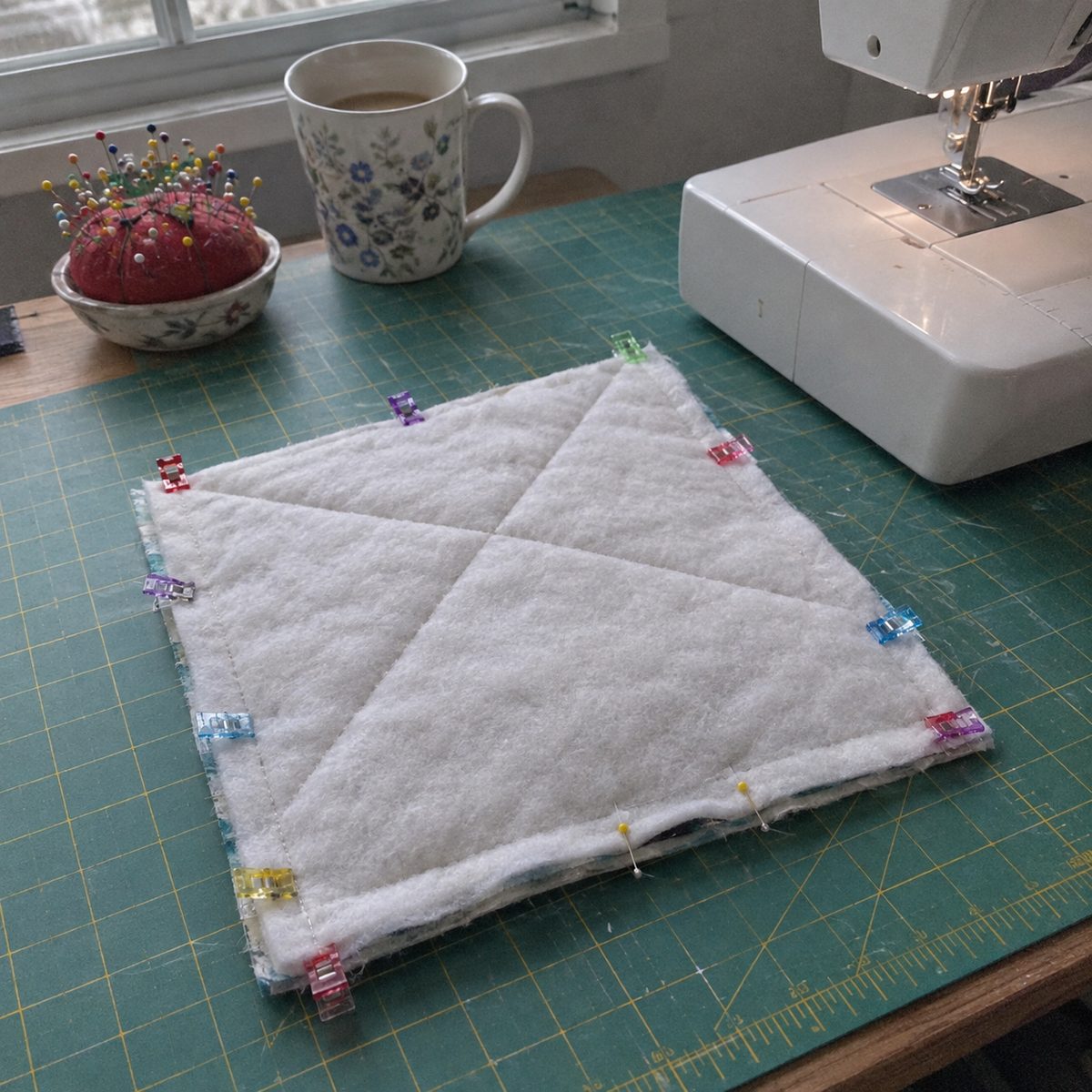
- Mark a 3 inch opening in the middle of one straight side. Sew around at 3/8 inch, stitch length 2.5, from one end of the opening to the other, backstitching at both. Pivot at each dart seam. The seam should cross each dart cleanly with no tuck.
- Trim the four corner points to 1/4 inch and clip into each corner, stopping two threads short of the stitching. Trim the batting in the side seam allowances to 1/4 inch too. Leave the opening at the full 3/8 inch.
Turn, press, and topstitch
- Turn the cozy right side out through the opening. Push each corner out with the chopstick until the dart point sits sharp, then run the chopstick along every edge from the inside to roll the seam right to the edge.
- Press the top edge all the way around with steam. At the opening, fold both allowances in at 3/8 inch so the fold matches the sewn edge on either side, and clip it shut. From the outside the opening should be invisible.
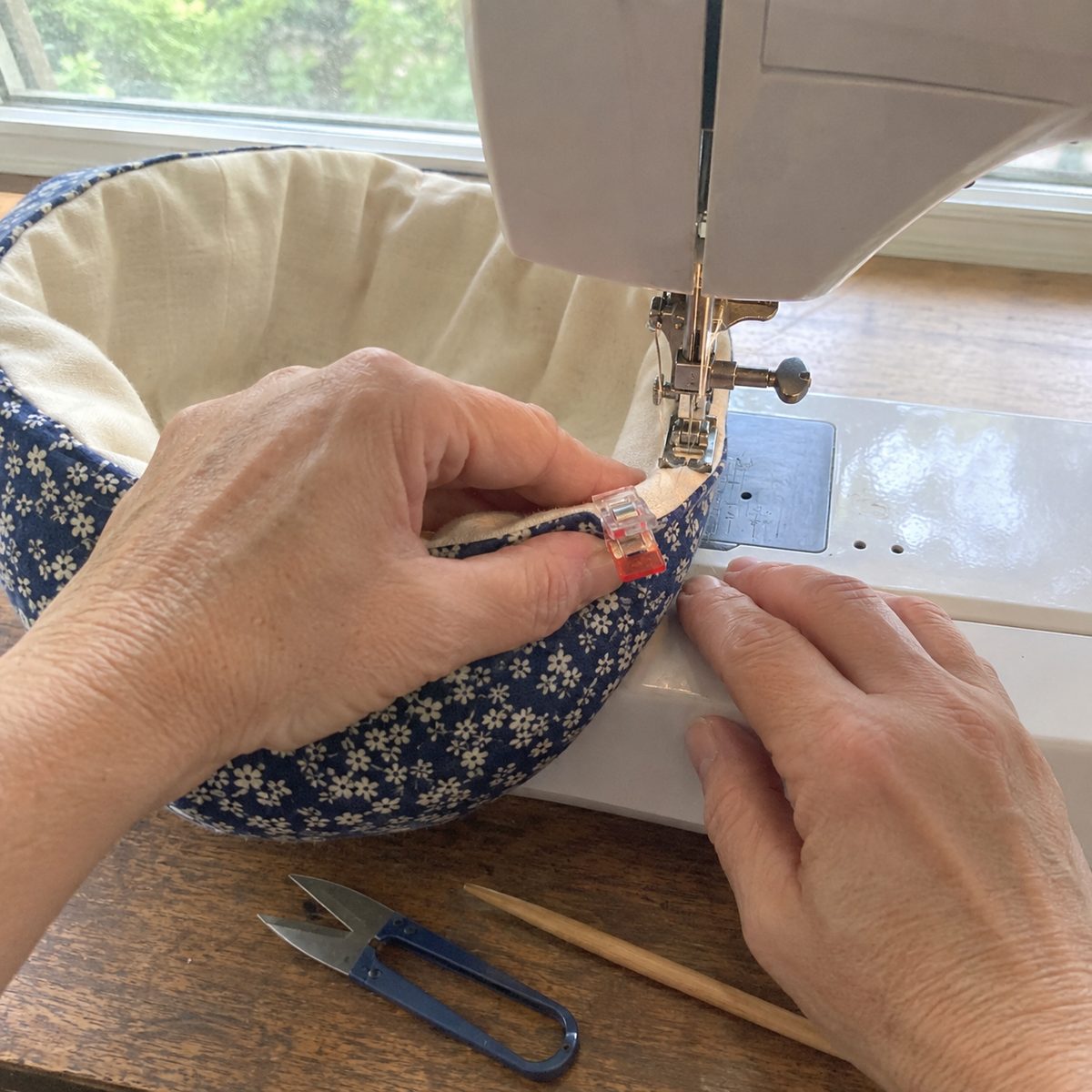
- Topstitch 1/4 inch from the edge all the way around, stitch length 3.0, starting at the opening and overlapping the start by 1/2 inch. Pivot at the four dart points. One even line of stitching, the same distance from the edge the whole way.
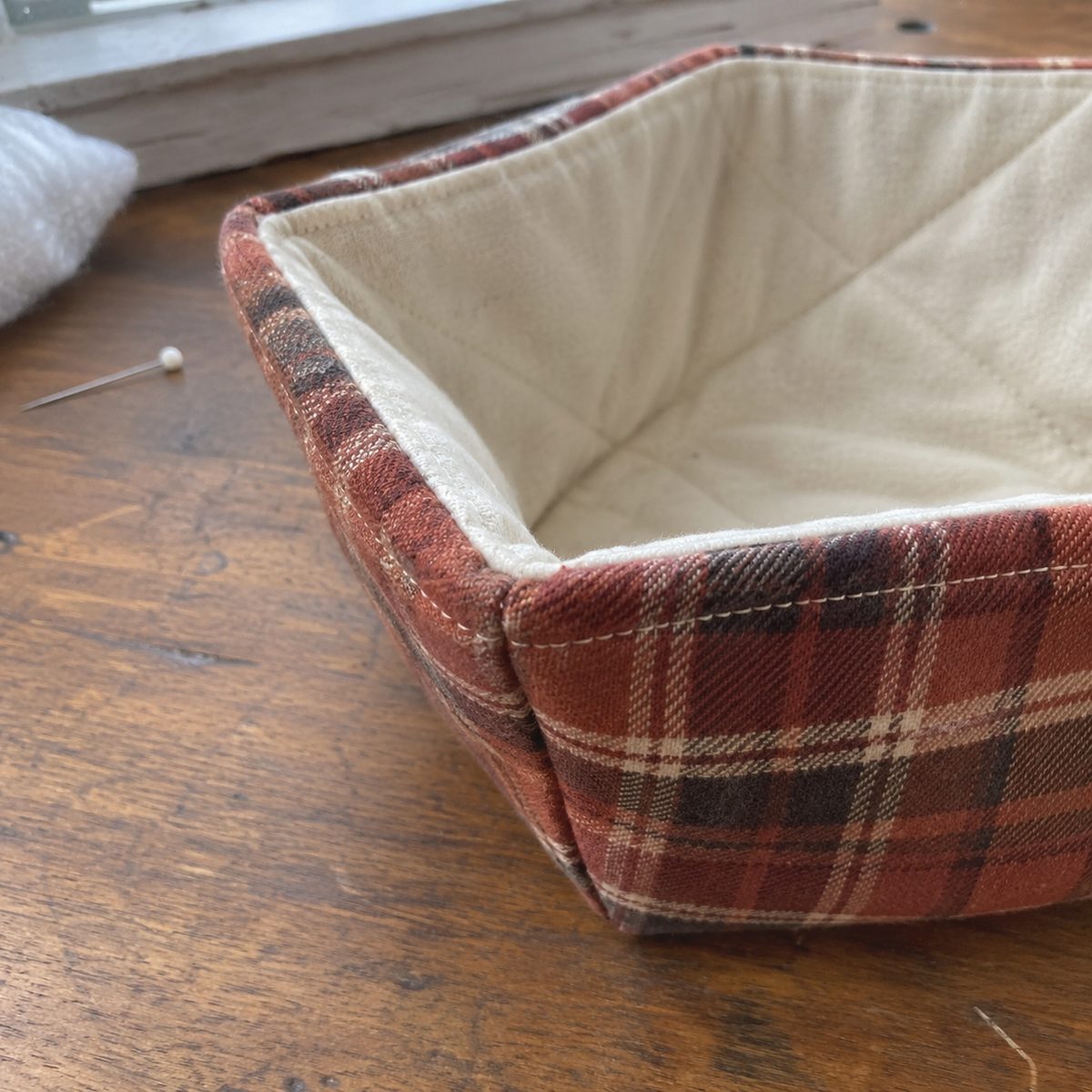
- Pinch each corner and press the dart crisp from the outside. Set a bowl in it. The rim should come up about 2 1/2 inches and the base should sit flat.
- For the first use, put a bowl of soup in the cozy, microwave for one to two minutes, and keep an eye on it. Warm but comfortable to hold is right. Never heat an empty cozy. Microwaves heat the water and fat in food, and a dry cozy with nothing in it has nothing to absorb the energy safely.
Fixes for the things that go wrong
The darts do not line up when I nest the two pieces
One square was trimmed after quilting and the other was not, or the template slipped. If the corners are off by 1/4 inch or less, pin the dart seams together anyway and ease the difference along the straight sides. The topstitching hides it. Any more than that, unpick the longest dart and resew it to match.
The cozy smelled scorched or has a brown spot after microwaving
Something in it is not cotton, or it went in empty or soaking wet. A brown spot at the needle holes is melted polyester thread. A brown patch on the fabric means it ran empty or the batting is wrong. Retire that cozy to the pot holder drawer.
The topstitching made the rim ripple
The feed dogs pulled the bottom layer while the presser foot held the top one back. Put the walking foot on, lengthen the stitch to 3.0, and lower the presser foot pressure if your machine allows it. A steam press afterwards relaxes most of the ripple.
The corners stick up like little ears
The dart point stopped short of the fold, or the dart is too shallow. For a mild ear, pinch the corner and press hard with steam. For a bad one, unpick the dart and resew it a scant 1/8 inch deeper, with the point exactly on the folded edge.
Sizes, seasonal fabrics, and gift sets
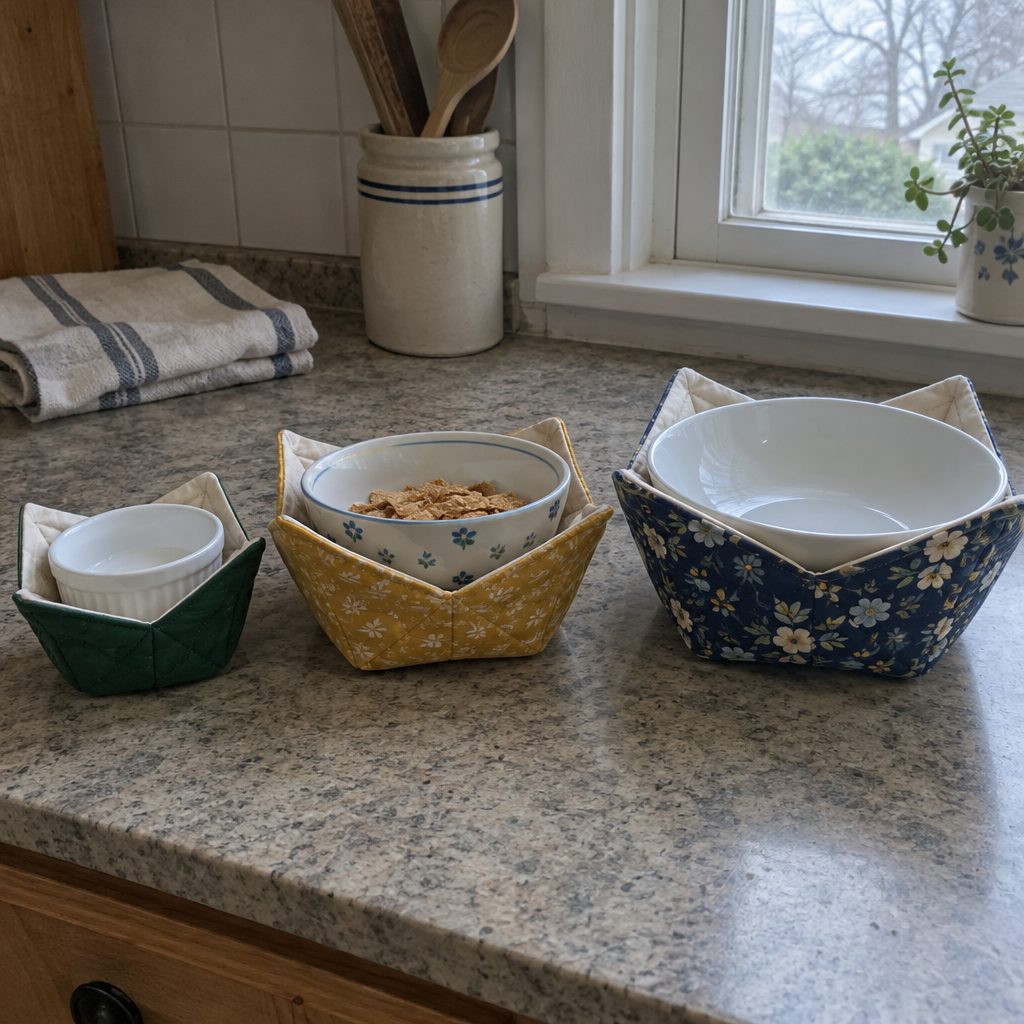
Resize by changing the square and the dart together. An 8 inch square with a 3/4 by 1 1/2 inch dart makes a small cozy for a ramekin or a 2 cup dessert bowl. A 12 inch square with a 1 1/4 by 2 1/2 inch dart fits a pasta bowl. The 3/8 inch seam and 1/4 inch topstitching stay the same for every size.
For November, I like a cotton plaid flannel outside and a plain cotton inside, so the cozy is reversible. Check the flannel label as carefully as the quilting cotton, because a lot of plaid flannel is a cotton-polyester blend. A navy or deep green solid gets used all winter.
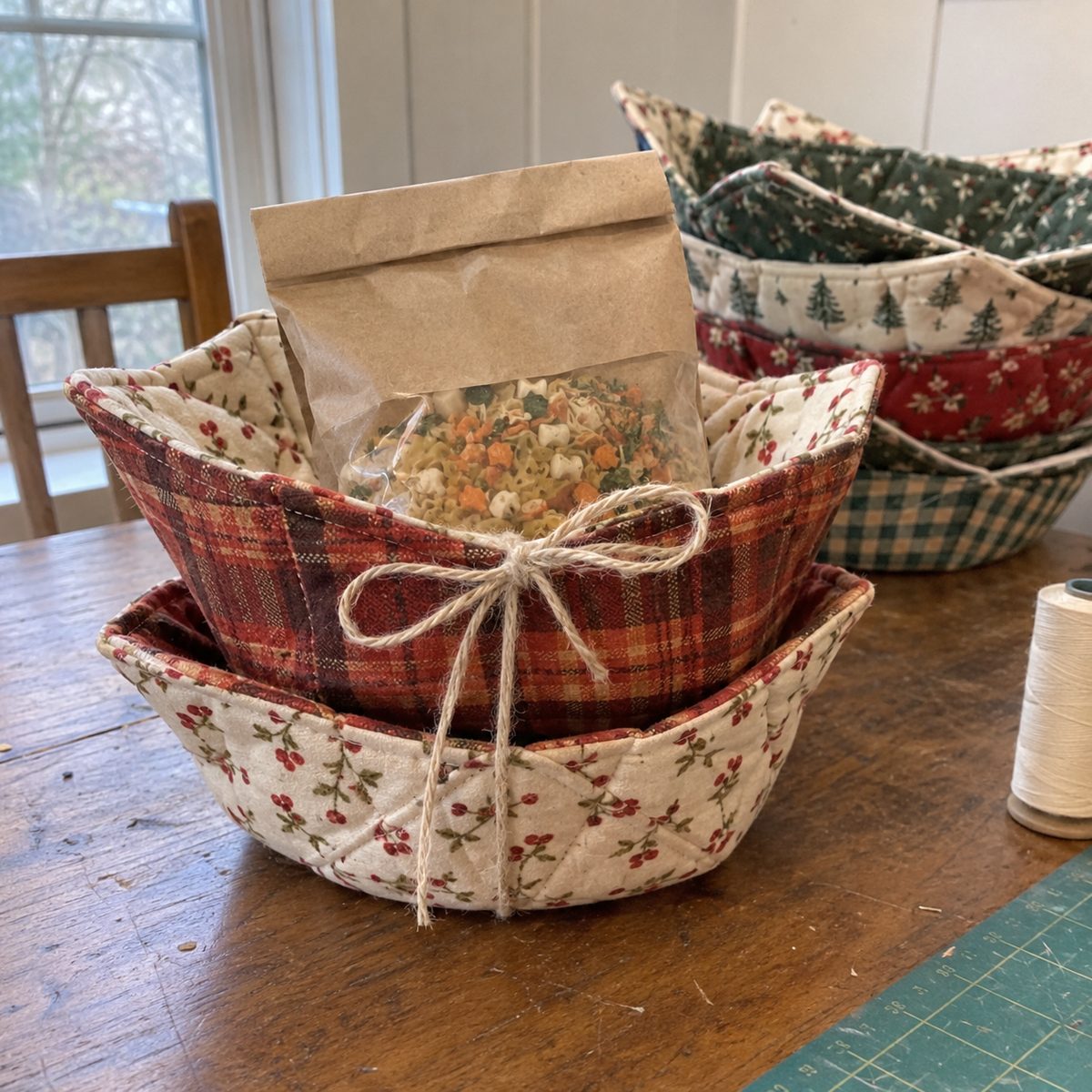
As a gift, two cozies stacked and tied with cotton twine, with a note that reads “100% cotton, microwave safe with a bowl of food inside”, is the stocking stuffer I make the most. Tuck a packet of soup mix into the top one. Of all the handmade gifts I sew, this is the one people ask for again.
For a batch, one yard of 44 inch cotton cuts twelve 10 inch squares, so a yard each of two fabrics plus a yard of Wrap-N-Zap makes six reversible cozies. Quilt all the squares first, then chain-sew the darts without cutting the thread between them. Six cozies take me about two and a half hours.
Frequently asked questions
Are fabric bowl cozies really microwave safe?
Yes, when every component is 100% cotton and there is food in the bowl. Cotton has no plastic to melt and very little moisture to heat, so the cozy stays warm rather than hot for a one to three minute reheat. The risk comes from polyester thread, blend fabric, scrim or fusible batting, and running it empty or wet.
Can I use Warm and Natural batting for bowl cozies?
Plenty of people do, and I used to. It is cotton, but it is needle-punched through a thin polypropylene scrim that holds the fibers together. Polypropylene is a plastic, and I stopped microwaving it once I learned that. Wrap-N-Zap costs about the same, has no scrim, and is sold for exactly this use.
Can I use polyester thread if the fabric and batting are cotton?
No. The thread is the first thing to go. Polyester softens around 480 degrees Fahrenheit, and the needle holes along a seam concentrate heat exactly where the thread sits. The result is a row of tiny hard brown beads and a scorched smell. Cotton thread costs a few dollars more.
How do I wash bowl cozies?
Machine wash warm with the regular laundry and tumble dry on low. Skip fabric softener and dryer sheets, which coat the fibers with something I would rather not heat up with my lunch. The first wash shrinks the batting slightly and gives the cozy a crinkled look. Dry it fully before it goes back in the microwave.
Once there are two of these on the counter, the dish towel stops coming out at lunchtime. Make the first pair in prints you like, then cut a stack of squares for December, because everyone who eats soup at your table is going to ask for one.