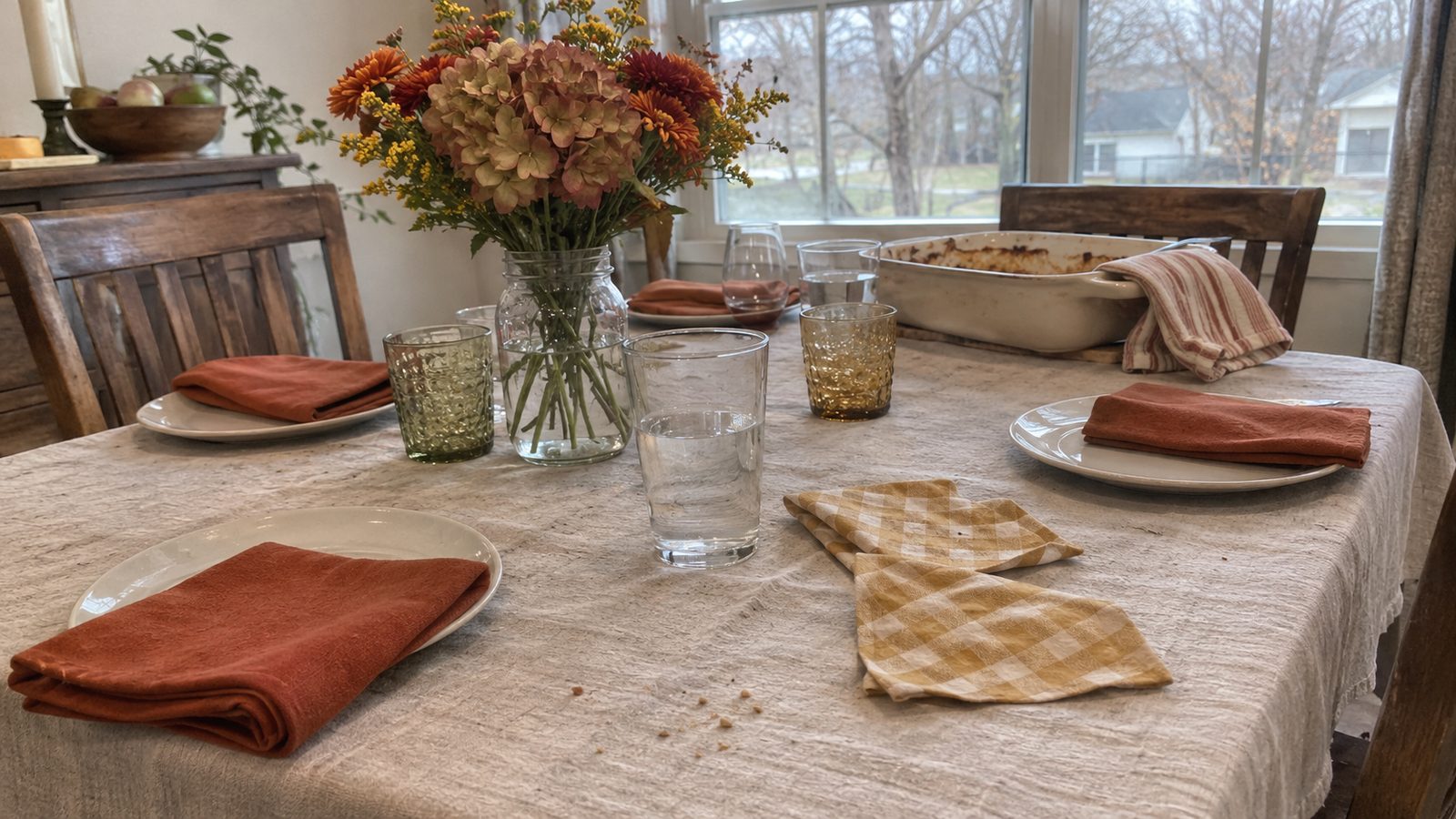
A cloth napkin is a hemmed square of cotton or linen, and the good ones have mitered corners, where the two hems meet on a 45 degree seam instead of piling up in a lump. Dinner napkins finish at 18 inches. Cocktail napkins finish at 12. One dinner napkin takes about 25 minutes once the fabric is washed, and a set of eight is a long afternoon.
This is a beginner project with one fussy spot. Four straight hems, four corners, done.
The corner is the whole thing. A sewn miter with a sharp point and a flat seam is what separates a napkin from a square with the edges turned under, and it is worth one practice run on a scrap before you cut the good linen. There is time before Thanksgiving for a set of eight.
What you’ll need
- Fabric for dinner napkins: 1 1/4 yards of 44 inch quilting cotton or 54 to 58 inch linen makes four, 2 1/2 yards makes eight
- Fabric for cocktail napkins: 7/8 yard of 44 inch cotton makes six, 1 1/4 yards makes nine
- All-purpose polyester or 50 weight cotton thread matched to the fabric, one 250 yard spool for eight
- Universal needle, 80/12 for quilting cotton, 90/14 for midweight linen
- Hem gauge or seam gauge, and a chalk pencil
- Rotary cutter, mat, and a long acrylic ruler
- Spray starch, or a spray bottle of plain water for linen
- A point turner, a chopstick, or a blunt knitting needle for the corners
| Piece | Cut size | Qty |
|---|---|---|
| Dinner napkin, finished 18 inches, 1/2 inch double-fold hem | 20 by 20 inches | 1 per napkin |
| Cocktail napkin, finished 12 inches, 3/8 inch double-fold hem | 13 1/2 by 13 1/2 inches | 1 per napkin |
| Lunch napkin, finished 16 inches, 1/2 inch hem | 18 by 18 inches | 1 per napkin |
| Formal dinner napkin, finished 20 inches, 1/2 inch hem | 22 by 22 inches | 1 per napkin |
| Eight dinner napkins from 44 inch cotton or 58 inch linen | Two across, four rows, 80 inches of length | 8 (2 1/2 yards) |
| Eight cocktail napkins from 44 inch cotton | Three across, three rows, 40 1/2 inches of length | 9 (1 1/4 yards, one spare) |
The math is the same for every size. A double-fold hem eats twice its width on each side, so a 1/2 inch hem takes 1 inch off each edge and a 20 inch square finishes at 18. For any other size, add 2 inches to the finished number.
Fabric: linen or cotton, and what to leave on the bolt
Linen is the napkin fabric, and it has been since the Romans wiped their hands on it. It releases gravy stains in a normal wash and looks better rumpled than cotton looks pressed. Buy midweight, 5 to 6 ounces per square yard, at $15 to $25 a yard. Lighter and the hems go limp. Heavier and the miters get thick.
Quilting cotton is the budget choice, and unlike with towels it works here, because a napkin only has to wipe a mouth, not dry a pot. Under $10 a yard, and it presses like paper. Pick a small, non-directional print. A large print gets chopped by the hem. Solids show off the corner. Prints hide the cranberry sauce.
Two to skip. Polyester blend tablecloth fabric will not hold a crease, so the miter never presses flat. Double gauze makes a wavy hem because its two layers move independently.
Prewash hot and dry hot, the way the napkins will be laundered after a holiday. Quilting cotton shrinks 2 to 3 percent, linen 4 to 6, close to an inch on a 20 inch square. Cut after washing, never before. My post on washing fabric before sewing has the why.
Press the washed yardage, then give cotton one light coat of spray starch so it cuts square and holds a crease through the corner work. Linen takes a crease better damp than starched, so keep a water bottle by the iron instead. The iron does the marking. The only chalk you need is one dot at each corner and one short line for the miter seam.
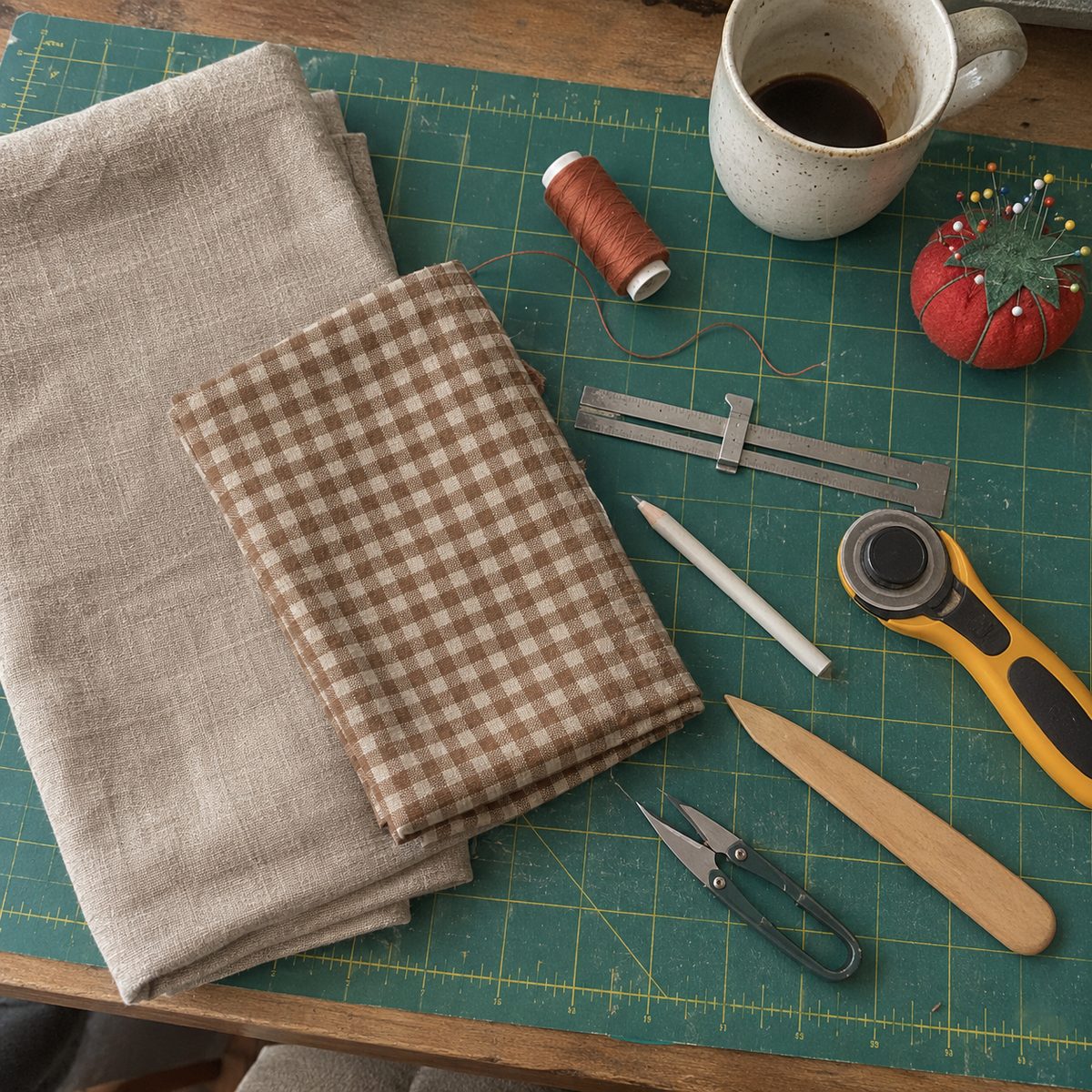
Cut true squares
A crooked square makes a crooked napkin, and no amount of pressing fixes it afterward.
- Snip 1/2 inch into one selvage, grab both sides, and tear across the full width. The torn edge follows one thread, so it is dead on grain. Press it flat, because tearing fuzzes about 1/4 inch.
- Line the ruler up on the torn edge and rotary cut a 20 inch strip, then cut the strip into 20 inch squares. From 44 inch cotton you get two squares and a 4 inch strip for the scrap bin. Cocktail napkins cut 13 1/2 inch strips, three across.
- Check each square by folding it corner to corner. The raw edges should match the whole way. If one pokes out more than 1/8 inch, the hem on that side will twist. Trim it true or recut.
- Stack the squares. You should have a tidy pile with crisp edges and no fuzz.
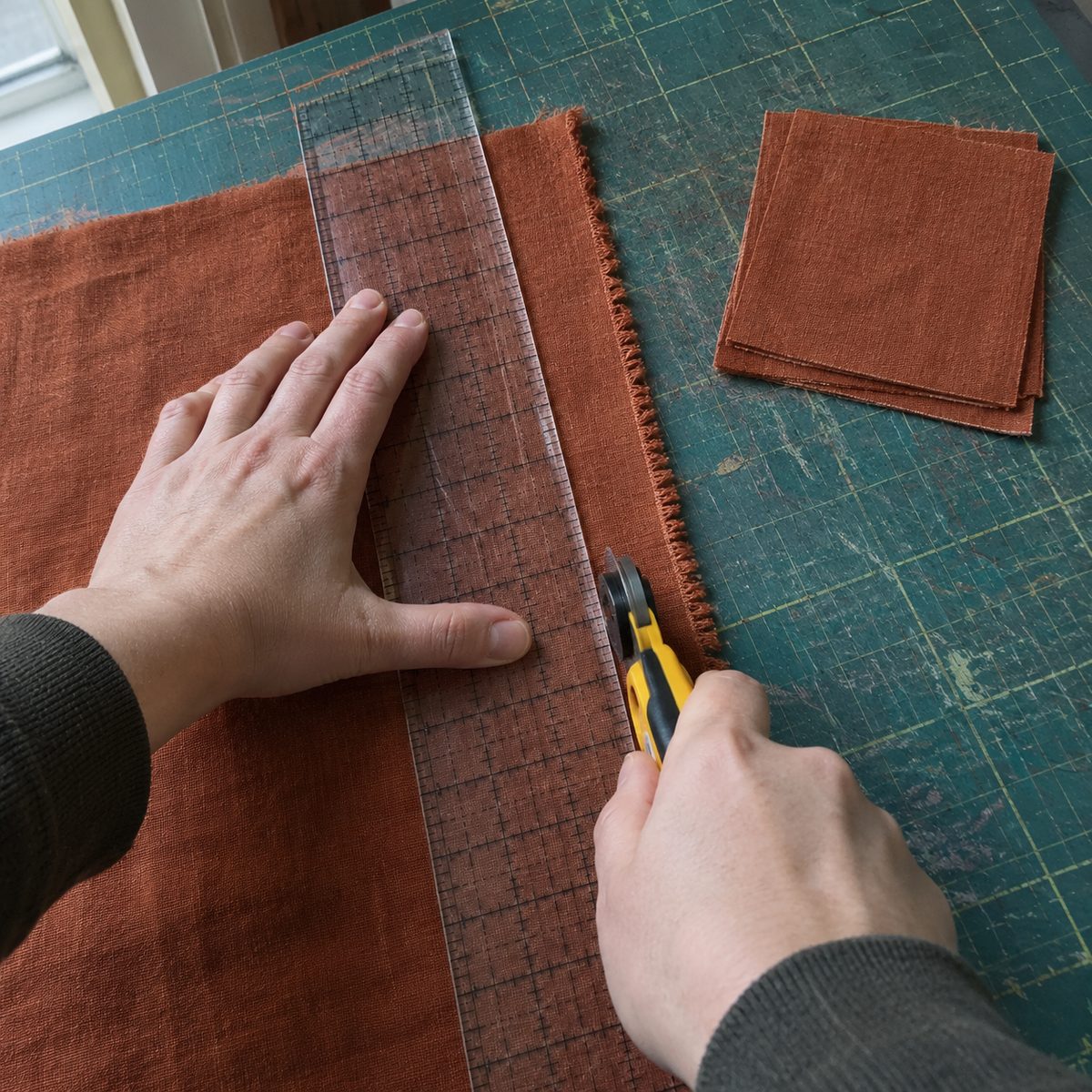
Press the double-fold hems
- Lay a square wrong side up. Fold one edge over 1/2 inch and press, checking with the hem gauge every 5 inches. On linen, spritz the fold first. Fold the same edge over another 1/2 inch so the raw edge is enclosed, and press again.
- Repeat on the other three sides. For cocktail napkins both folds are 3/8 inch. Each corner is now four layers deep, which is the bulk the miter will remove.
- Open all four hems back out flat. You should see two crease lines parallel to every edge, 1/2 inch and 1 inch in, crossing in a small grid at each corner. Mark the point where the two 1 inch creases cross with a chalk dot, all four corners.
- The square should look like a flat piece with a pressed frame and four dots. If any crease wanders, repress it now. The miter seam depends on these lines.
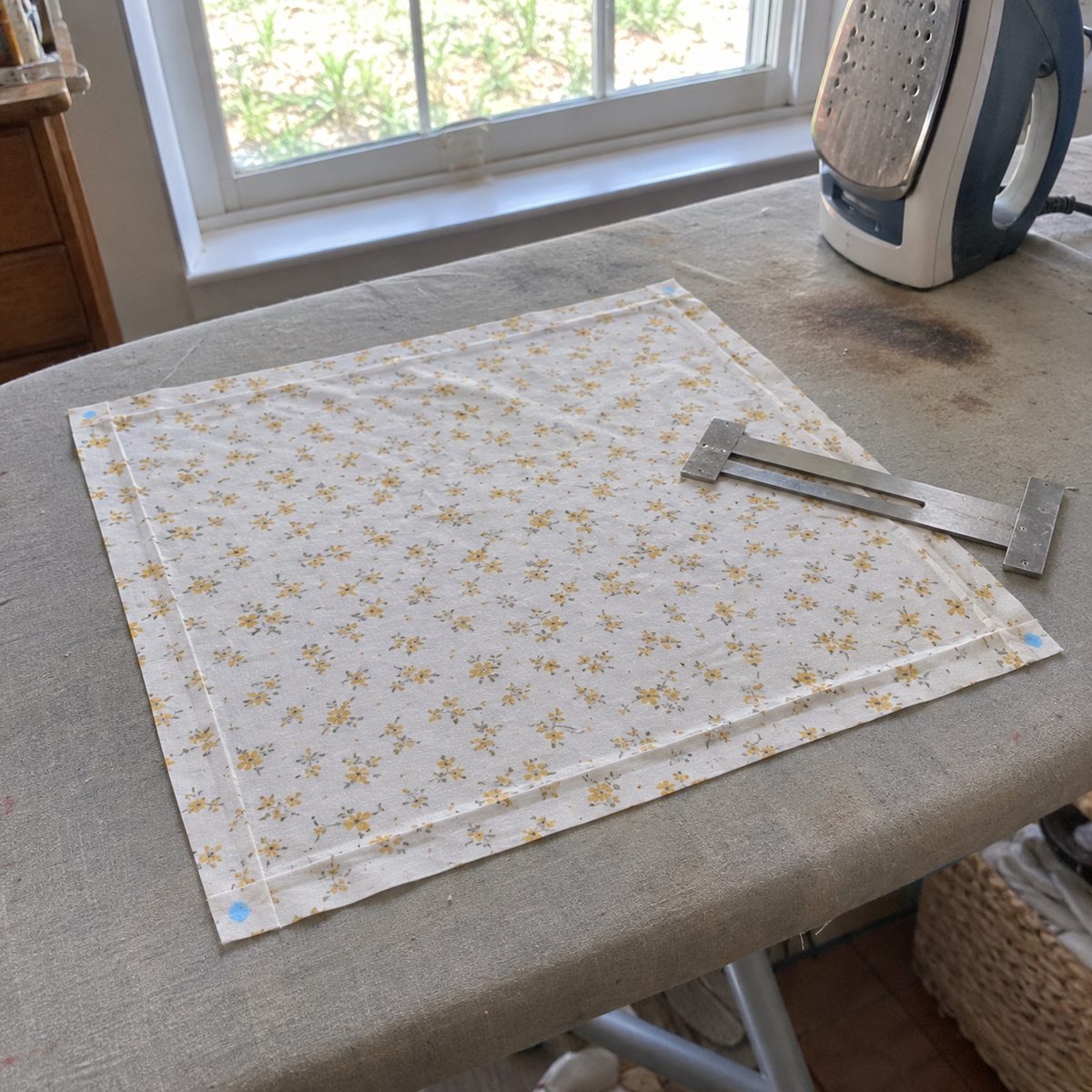
Sew the mitered corners
There are two miters. The folded miter, which I use on tea towels, tucks the bulk away and relies on the hem stitching to hold it. The sewn miter puts a real seam on the diagonal. It is sharper and flatter, and napkins get it.
- Fold one corner in half diagonally, right sides together, so the two adjacent raw edges line up exactly and the crease lines on one side sit on top of the crease lines on the other. The corner point is now at the end of a fold, and the chalk dot is sitting on the fold. Pin once.
- Draw a chalk line from the dot straight out to the raw edges, square to the fold. On a 1/2 inch hem the line is about 1 3/8 inches long. On a 3/8 inch hem it is about 1 inch.
- Set a 2.0 mm stitch. Sew on the line from the raw edges in, stopping with the needle exactly on the dot. Backstitch two stitches. Where you stop is the whole skill. Sew past the dot and the point puckers, stop short and there is a hole at the tip.
- Trim the seam allowance to 1/4 inch, cutting the little triangle off. Press the seam open with the point of the iron, holding it with a fingernail.
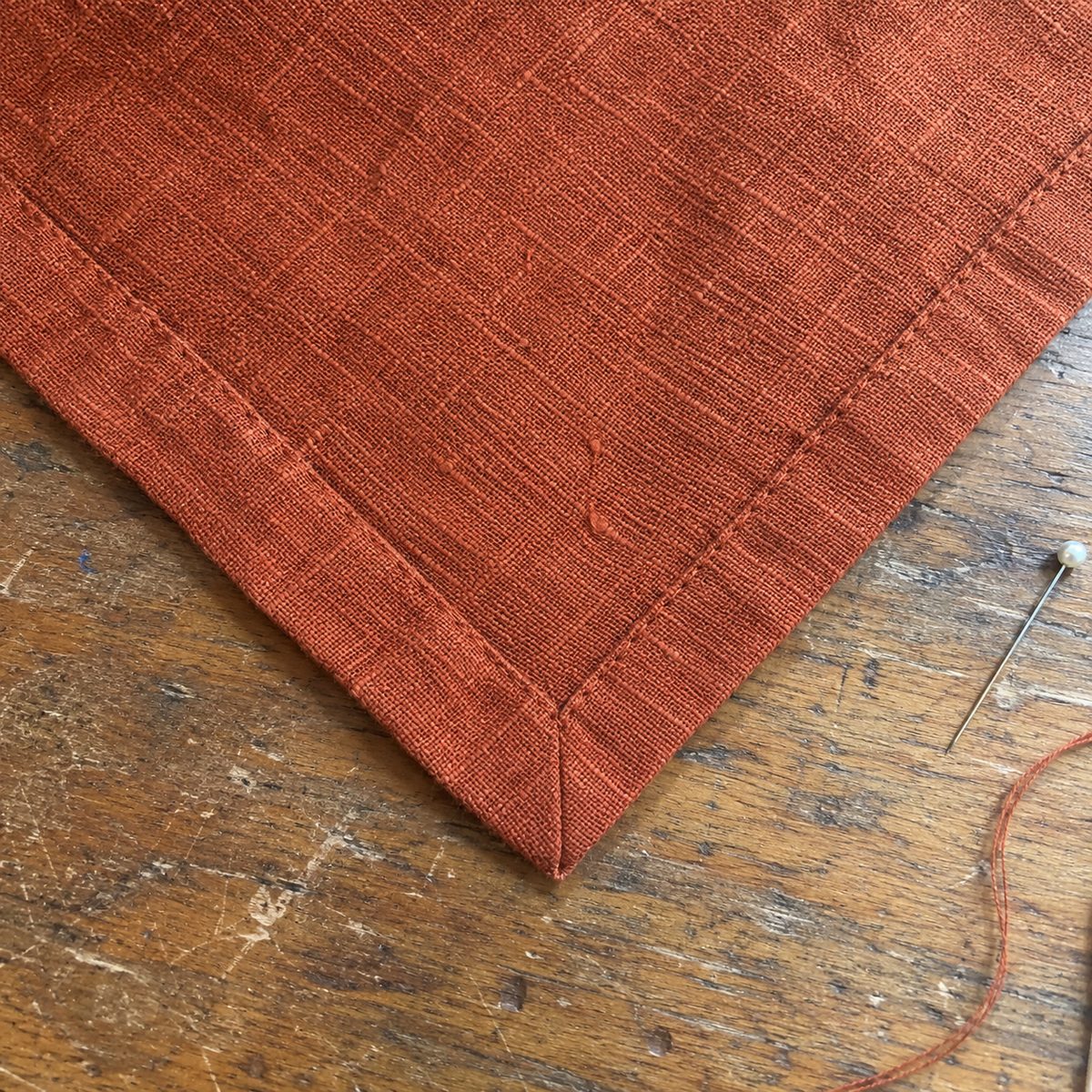
- Turn the corner right side out, push the point out with the point turner, and refold the hem on its creases on both sides. The seam should run in a straight 45 degree line from the sharp point to the inner corner of the hem, with the hem 1/2 inch wide on both sides of it. Press. Do the other three corners.
Topstitch the hems
- Lengthen to 2.8 mm for quilting cotton, 3.0 mm for linen, with the same thread top and bobbin, because you sew from the wrong side and the bobbin thread shows on the front. Test on a folded scrap.
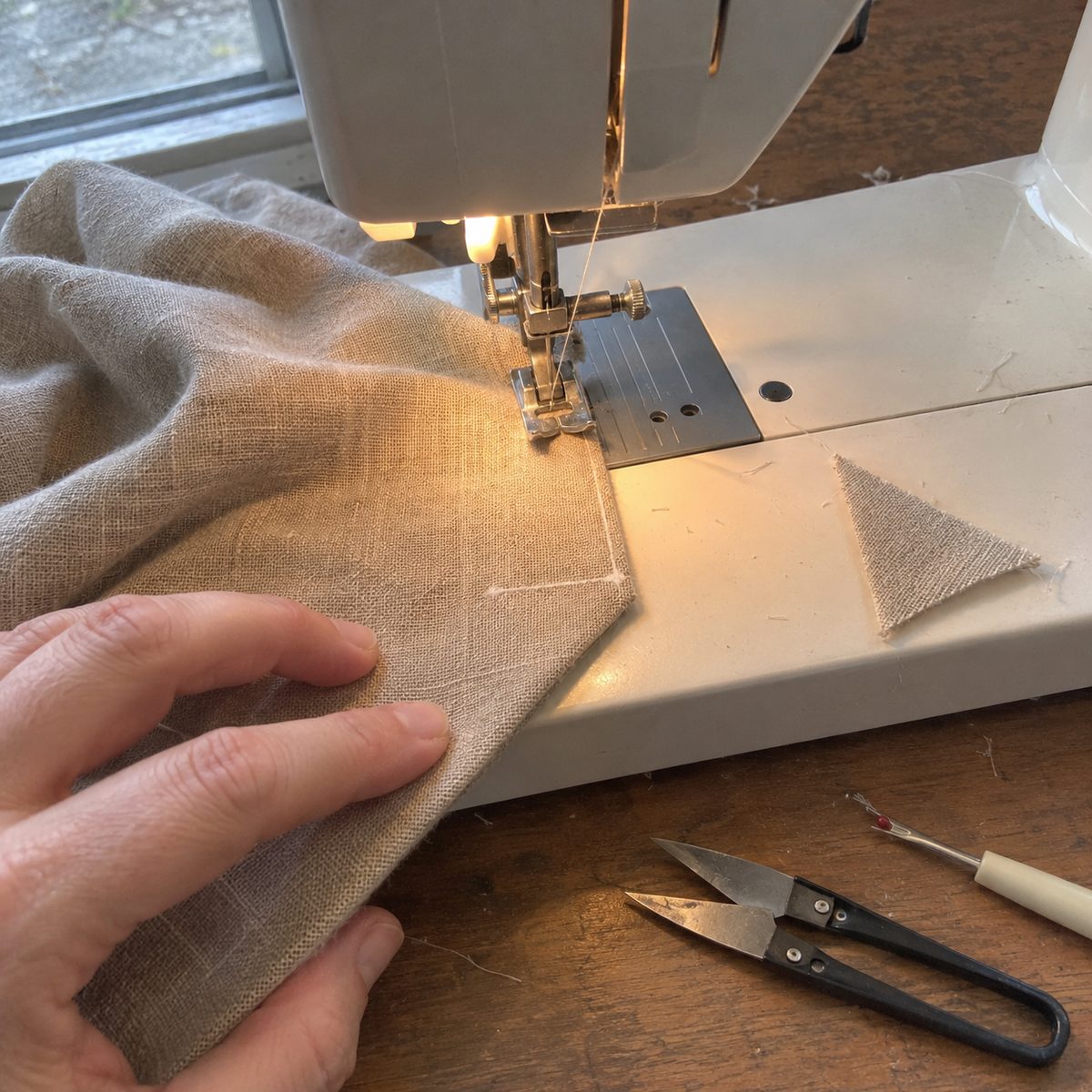
- Start in the middle of one side, wrong side up, and sew along the inner folded edge of the hem about 1/8 inch from the fold, with the bulk of the napkin to your left.
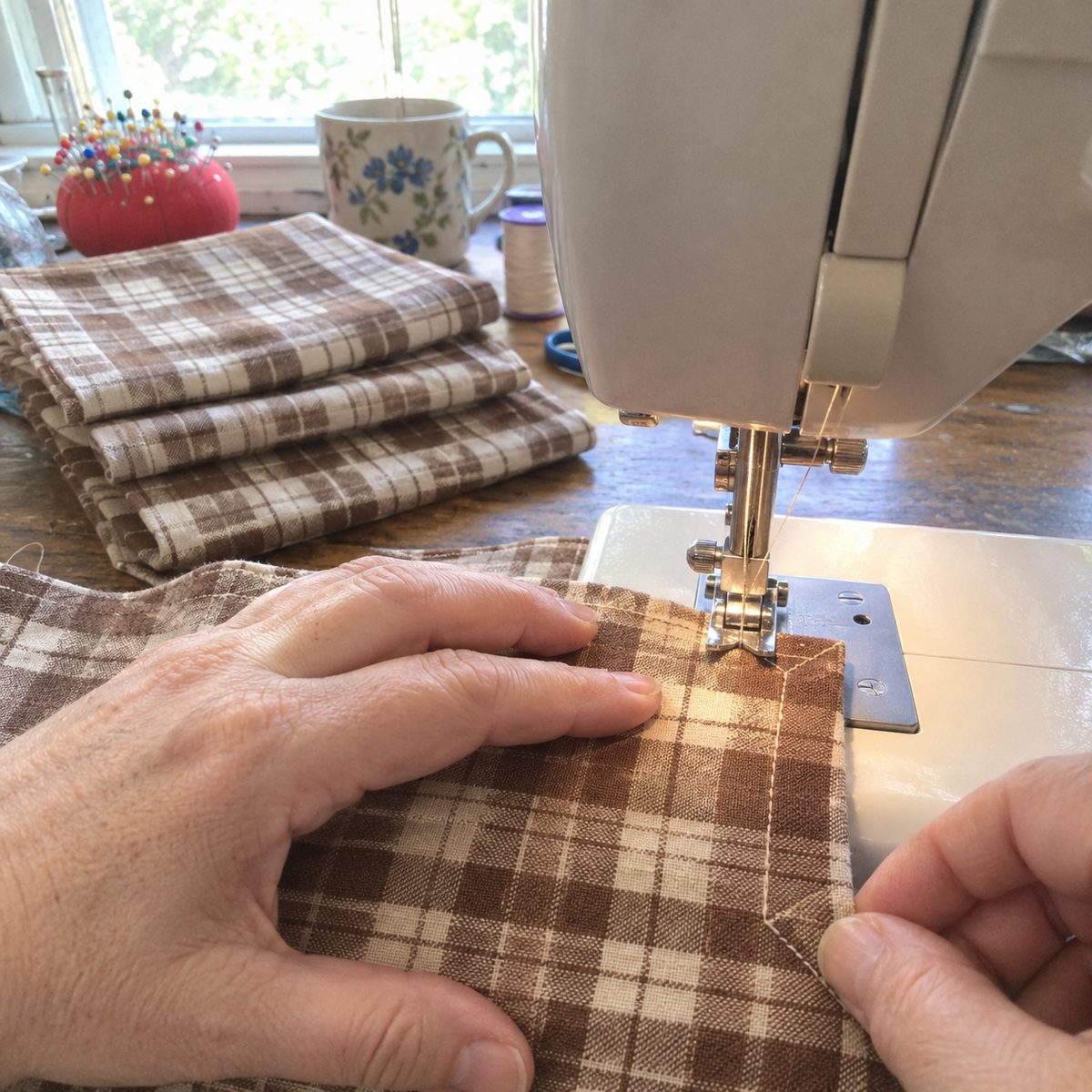
- At the corner, stop with the needle down where the stitching meets the inner end of the miter seam, lift the foot, pivot 90 degrees, and continue. The pivot lands right on the seam, which is how you know the miter is true.
- Go around all four sides, overlap the start by 1/2 inch, clip the tails, and press from the right side with steam. From the front you should see one unbroken square of stitching 3/8 inch in from the edge and four flat corners with a seam you can barely find.
For a dressier edge, sew a second row 1/8 inch from the outer edge, in the same direction as the first.
Fixes for the things that go wrong
The point is puckered or dimpled
You sewed past the chalk dot, or the miter seam was not trimmed and pressed open before turning. Unpick the last three stitches, resew to the dot, trim to 1/4 inch, and press the seam open before you turn it again.
There is a tiny hole at the tip
The seam stopped short of the dot, or the allowance was trimmed under 1/4 inch and frayed through. Turn the corner inside out and sew two more stitches to reach the dot. If the fabric is already frayed, close it from the wrong side with three small hand stitches in matching thread. Nobody will find it.
The miter seam does not land on the diagonal
The two hems were pressed at different widths, so the 1 inch creases crossed off center and the dot was in the wrong place. Measure both hems at that corner, repress the narrow one to match, mark a new dot, and resew. Checking every hem with the gauge while pressing saves this whole fix.
The hems ripple on linen
The stitch is too short, the fabric is being pushed into the foot, or the hem was sewn dry. Lengthen to 3.0 mm, let the feed dogs pull, and spritz the hem so it is slightly damp when you sew. A walking foot ends the problem on anything heavier than 6 ounces. Press from the right side with full steam and let the napkin cool flat.
Sizes, seasons, gift sets, and batch making
The cut chart covers four sizes, and the method does not change. A 16 inch lunch napkin is what most people want for everyday. The 12 inch cocktail size is where the prints go, because a small square can carry a print a dinner napkin cannot.
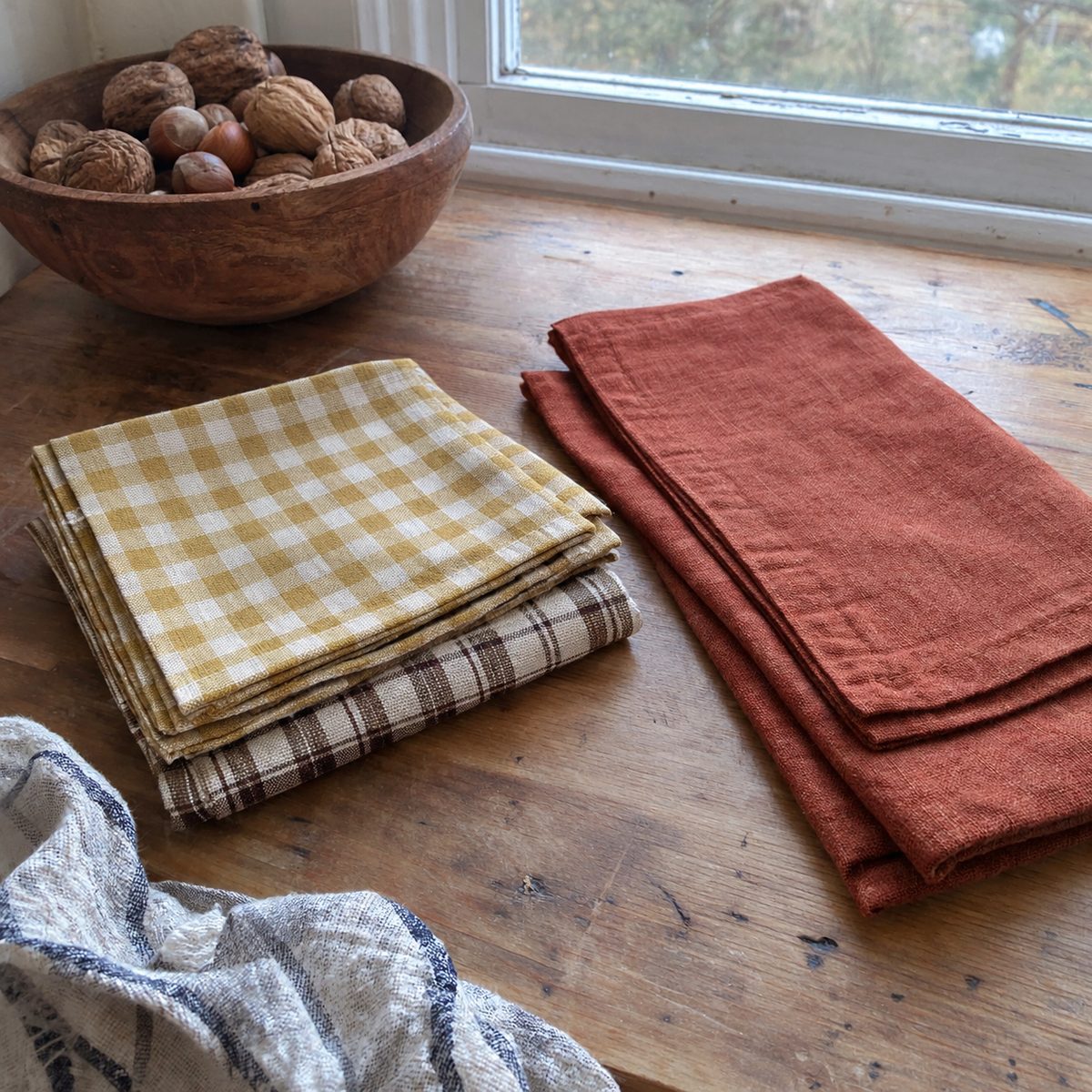
For Thanksgiving I keep the dinner napkins solid, rust or oatmeal linen, and let the cocktail napkins do the talking in a small mustard check or a brown and cream plaid. Two sizes on one table look like a set without matching. For December, red ticking cocktail napkins with white dinner napkins. The rest of my fall sewing projects pull from the same stack.
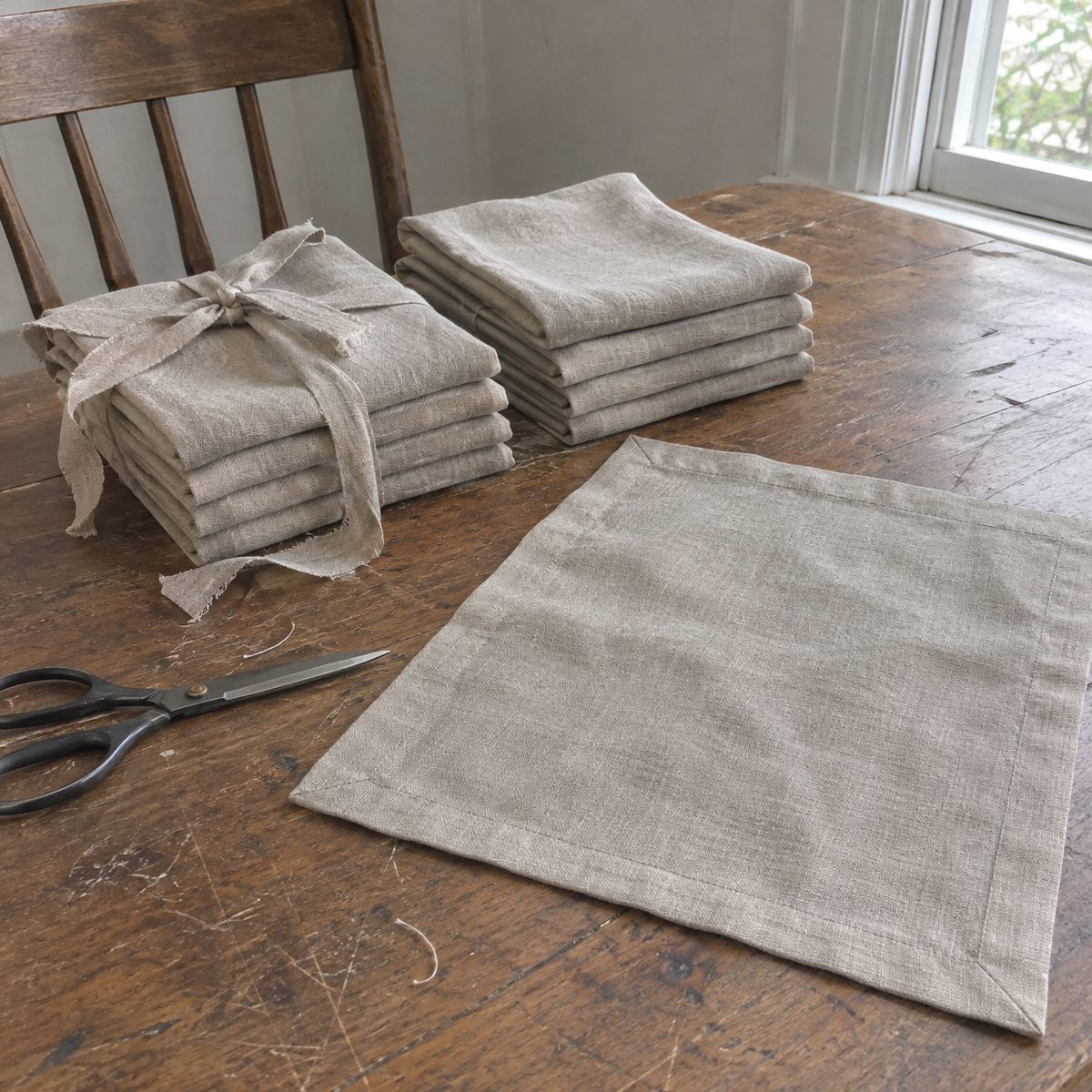
Four dinner napkins folded in quarters and tied with a strip of the same fabric is one of the easier handmade gifts to sew, and a hostess gift that gets used on the day. Cut a matching tea towel from the leftover yardage and the set looks planned. More of that sort of thing is on my kitchen sewing projects list.
Eight napkins is 32 corners, so work in batches. Cut all eight squares in one sitting, about 20 minutes. Press all 32 hems the next evening, about 45 minutes, dotting corners as you go. Sew all 32 miters in one run without cutting the thread between them, about 40 minutes with trimming and pressing. Topstitch all eight last, about 30 minutes. Two and a half hours over three evenings.
Frequently asked questions
What size should cloth napkins be?
Dinner napkins finish at 18 to 20 inches, lunch napkins at 16, and cocktail napkins at 10 to 12. An 18 inch napkin folded in quarters is a 9 inch square, which sits neatly to the left of the forks or on the plate. For most tables 18 is the right answer.
How much fabric do I need for eight napkins?
For 18 inch dinner napkins, 2 1/2 yards of 44 inch quilting cotton or 54 to 58 inch linen, cut two across in four rows. For 12 inch cocktail napkins, 1 1/4 yards of 44 inch cotton gives you nine, three across in three rows. Both numbers allow for shrinkage.
Do I have to miter the corners?
No. A plain double-fold hem that overlaps at the corners takes 5 minutes less per napkin and holds up fine. The corner will be eight layers thick and will not lie flat, and it looks like a kitchen rag next to a mitered one. Miter the napkins you set a table with.
How do I keep linen napkins from looking wrinkled?
Pull them from the dryer while still damp, shake them out, and press them right then with a hot iron and steam, folding as you go. Dry linen does not press well. If you miss the window, spritz each napkin and roll it in a towel for 10 minutes before ironing. Or decide the rumple is the point of linen.
Make one napkin start to finish before you cut the set, so your first four miters happen on a napkin that lives in the drawer. By the eighth the chalk dot and the pivot are automatic, and you will start noticing lumpy corners on store-bought napkins. Eight on the Thanksgiving table, pressed and folded, and no one will know they took two and a half hours.