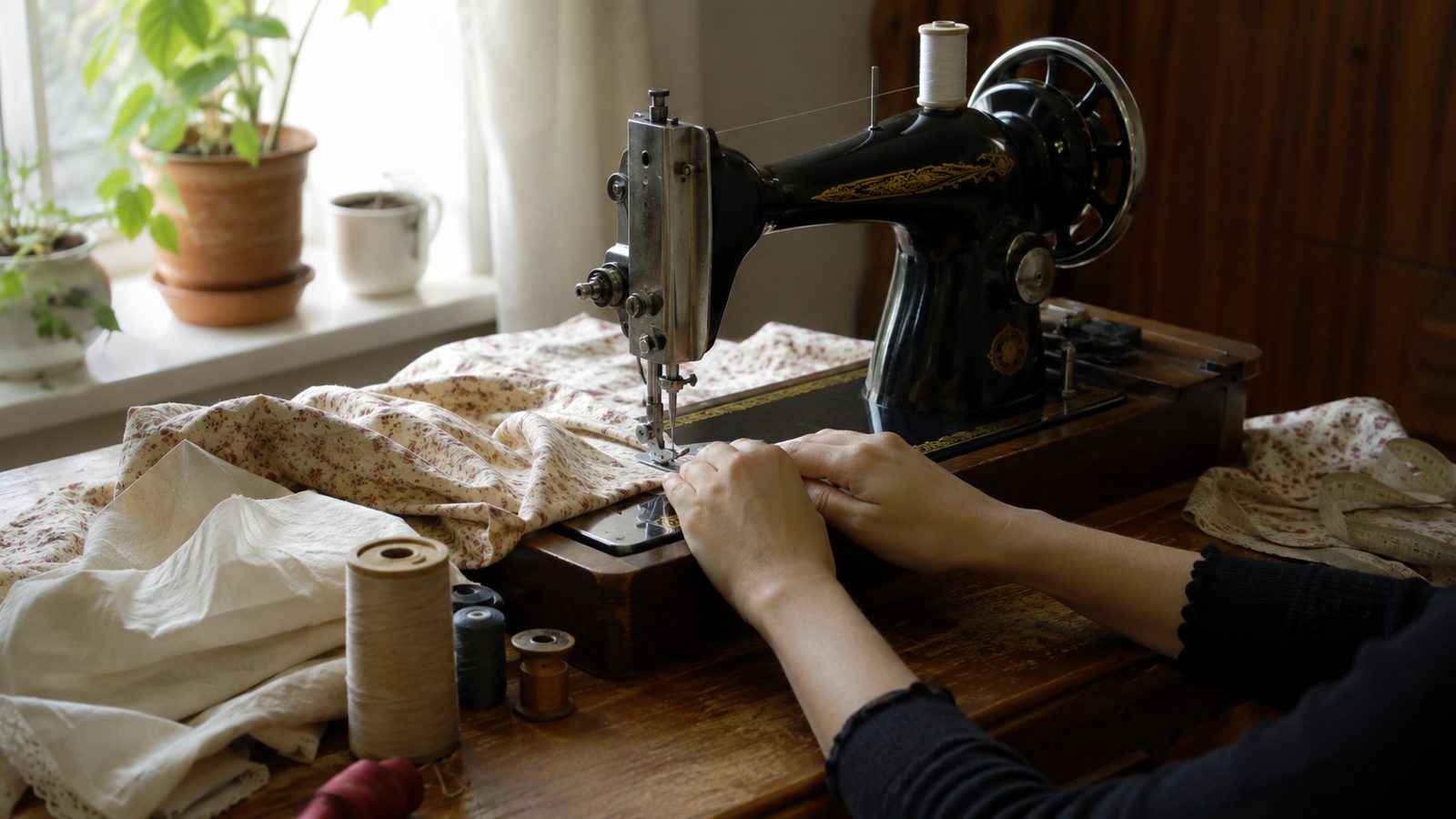
Few brand names are as tied to a craft as Singer is to sewing. For many of us, the first machine we ever touched was a Singer, whether it was a grandmother’s black-and-gold treadle, a school home-ec machine, or a starter model unboxed on a kitchen table. The company has been making sewing machines since 1851, and it still sells one of the widest ranges of home machines in the US today.
Modern Singer is a very different company from the one that once ran its own factories and storefront sewing centers, though. Today it is one of three brands under SVP Worldwide, alongside Husqvarna Viking and Pfaff, and its lineup leans toward approachable, widely available machines for home sewists: beginner mechanicals, the popular Heavy Duty family, computerized quilting models, sergers and a handful of sewing-and-embroidery combos.
AT A GLANCE
- Founded: 1851, New York City, as I. M. Singer & Co.
- Founders: Isaac Merritt Singer and Edward Clark
- Headquarters: Nashville, Tennessee area (parent company SVP Worldwide; US consumer operations in La Vergne, Tennessee)
- Parent company: SVP Worldwide, majority-owned by Platinum Equity since 2021
- Known for: The Heavy Duty machine family, easy-to-find beginner machines, and a long history of sewing firsts
- Best for: Beginners, budget-minded home sewists, and anyone who wants a sturdy everyday machine for garments, home decor and mending
A short history of Singer
Singer did not invent the sewing machine, but it did more than any other company to put one in ordinary homes. Isaac Merritt Singer and his business partner, lawyer Edward Clark, founded I. M. Singer & Co. in New York City in 1851, the same year Singer received the patent for his first machine (issued August 12, 1851). The company became the Singer Manufacturing Company in 1865 and took the name The Singer Company in 1963.
Clark’s contribution was as important as Singer’s mechanics. The company pioneered selling machines on an installment, or hire-purchase, plan, so families could pay over time instead of all at once. That idea helped turn an expensive piece of equipment into a household staple.
Growth came quickly. According to Singer’s own history, the brand won first prize at the 1855 World’s Fair in Paris and became the largest-selling sewing machine brand internationally that same year. Singer introduced a lightweight domestic machine nicknamed the Grasshopper in 1858, the “New Family” machine in 1865, and what it describes as the first practical electric sewing machine in 1889.
Singer also built on a massive scale overseas. Its Kilbowie factory in Clydebank, Scotland, opened in 1882 and became the largest sewing machine factory in the world, producing roughly 36 million machines before it closed in 1980. Back in New York, the 47-story Singer Building, completed in 1908, was briefly the tallest building in the world.
Several milestone machines came in the twentieth century. The Featherweight 221 was introduced at the 1933 Chicago World’s Fair and is still one of the most collected vintage machines, prized by quilters for its light weight and beautiful straight stitch. It is a vintage, discontinued model today, so if you want one, you are shopping the secondhand and restoration market. Singer followed with the Slant-o-Matic zigzag machine in 1952, the electronic Athena 2000 in 1975 and the computer-controlled Touchtronic 2001 in 1978.
The later decades were rockier. The Clydebank plant closed as the home sewing market shrank, the corporation went through several ownership changes, and it filed for bankruptcy in 1999. Kohlberg & Company acquired Singer in 2004, and a 2006 merger combined it with the owner of Husqvarna Viking and Pfaff to form what is now SVP Worldwide. In 2021, private equity firm Platinum Equity acquired a controlling stake in SVP Worldwide, which says its three brands account for more than one in three consumer sewing machines sold worldwide.
What Singer is known for
Availability. Singer machines are easy to find, both on Singer’s own site and at big-box and craft retailers. That also makes accessories like bobbins and presser feet easy to track down.
The Heavy Duty family. If Singer has a signature product line today, this is it. Heavy Duty machines pair a stronger motor and a metal interior frame with a stainless steel bedplate, and Singer markets them for denim, canvas and other thick fabrics while keeping them approachable enough for everyday sewing.
Beginner-friendly design. Many Singer machines share the same easy-to-learn features: a top drop-in bobbin you can watch through a clear cover, one-step buttonholes, built-in needle threaders on many models, and a free arm for hems and cuffs. Singer also supports new sewists with its SINGER Sewing Assistant App, which the company says was the world’s first sewing assistant app when it launched in 2017.
A long tradition of firsts. Zigzag, electronic and computer-controlled home machines all have Singer chapters in their history, and the brand is still experimenting. Its newest machines connect to Singer’s CREATIVATE app, and it has expanded into craft cutting machines and heat presses under the MOMENTO name.
Singer’s current sewing machine lineup
Singer’s US lineup changes often, with new colors, bundles and model numbers appearing regularly. Here is how the range breaks down today, with a few example models I confirmed on Singer’s US site.
Mechanical and beginner machines
These are Singer’s simplest machines: dial-selected stitches, preset or easily adjusted stitch length and width, and very little to go wrong. The Simple 3337 is a long-running example with a top drop-in bobbin, one-step buttonhole and free arm. Singer’s compact M-series machines, such as the M3500, cover basic, stretch and decorative stitches in a portable body. If you just want to hem pants and fix seams, the lightweight M1000 mending machine is built for light- to medium-weight repairs, and Singer itself recommends a full-size machine for thicker fabrics. Browse more options in our best sewing machines for beginners guide.
Heavy Duty machines
This is Singer’s biggest family, spanning both mechanical and computerized models. The classic Heavy Duty 4432 and Heavy Duty 4452 are still sold, with the 4452 adding a set of specialty presser feet, including a Non-Stick Foot for vinyl and leather. In 2026 Singer added the “Next Evolution” Heavy Duty models, from the entry-level Heavy Duty 4511 (11 essential stitches) to the Heavy Duty 4552 (32 built-in stitches, speed control, and a walking foot and Non-Stick Foot included). For more stitches and a wider work area, the computerized Heavy Duty 6700C adds lettering and a 6.4-inch throat space.
Computerized and quilting machines
Singer’s computerized machines add LCD screens, needle up/down, speed control and large stitch libraries. The Patchwork 7285Q is aimed at quilters, with programmable needle up/down and a speed control lever for free-motion work, while the C5980Q Patchwork Plus includes an extension table and drop feed. The Quantum Stylist 9960 is Singer’s feature-packed option for decorative sewing, with lettering fonts, stitch mirroring and an automatic thread trimmer. Quilters comparing brands should also see our best sewing machines for quilting roundup.
Sewing and embroidery combos
Embroidery is a smaller part of Singer’s range. The SE9180 combines sewing and embroidery with a 7-inch touch screen, built-in embroidery designs and CREATIVATE connectivity. At the time of writing, Singer was also taking pre-orders for the Smart Heavy Duty 9120, a Heavy Duty sewing machine controlled through the CREATIVATE app that includes an embroidery unit.
Sergers
Singer sells several sergers for finishing seams the way store-bought clothes are finished. The S0100 is a straightforward 2/3/4-thread model with differential feed and a free arm. The newer Heavy Duty 0460 serger adds an LED-lit looper area to make threading easier, along with a heavy duty motor and a metal interior frame. Not sure you need one yet? Our serger vs. sewing machine guide explains the difference.
Things to know before you buy
First, read the stitch counts carefully. Singer usually advertises “stitch applications,” a figure that counts variations of the same stitch. That makes the number larger than the count of distinct built-in stitches, so compare features rather than headline numbers when you shop across brands.
Second, “Heavy Duty” means heavy duty for a home machine. These models are designed for denim, canvas and vinyl in a way a basic starter machine is not, but they are still household machines, not industrial machines built for all-day upholstery or thick leather work. Go slowly on very thick seams and use the right needle.
Third, the lineup changes constantly. Singer releases new colors, bundles and model numbers often, and older models linger at retailers long after they leave Singer’s own site. Two machines with nearly identical names can differ in stitches, accessories or construction, so check the exact model number against the manufacturer’s listing.
Fourth, think about support. Singer machines are mostly sold through mass retailers and online rather than through local dealers who include lessons and in-person servicing with a purchase. If hands-on dealer support matters to you, factor that in. Either way, it helps to learn basic troubleshooting. Our guide to common sewing machine problems covers most of the issues that send new sewists back to the store.
Finally, Singer’s strongest territory is the entry level and the midrange. If you want high-end embroidery or a large-throat quilting machine, look at Singer’s sister brands or other premium makers too.
Which Singer machine is right for you?
- Complete beginners: A simple mechanical model like the Simple 3337, or an entry Heavy Duty like the 4511 if you expect to sew thicker fabrics.
- Garment sewists and crafters working with denim, canvas or vinyl: The Heavy Duty family, especially the 4452 or 4552 for their extra presser feet.
- Quilters: The Patchwork 7285Q or C5980Q for needle up/down, speed control and drop feed, or the computerized Heavy Duty 6700C if you also want its larger throat space.
- Decorative sewists: The Quantum Stylist 9960 for lettering and a big stitch library.
- Embroidery-curious sewists: The SE9180 for a combined sewing and embroidery machine.
- Anyone who wants professional seam finishes: Add a Singer serger such as the S0100 or Heavy Duty 0460.
- Mending only, or small spaces: The M1000 or another compact M-series machine.
Frequently asked questions
Are Singer machines good for beginners?
Yes, for most beginners. Singer’s entry-level mechanical machines and its basic Heavy Duty models are easy to learn, widely sold and backed by Singer’s online resources and Sewing Assistant App. Just match the machine to your projects: a light mending machine will frustrate you on jeans, and a stitch-packed computerized machine can be more than you need at first.
Where are Singer sewing machines made?
New Singer machines are made overseas, not in the US. Singer’s parent company, SVP Worldwide, runs its manufacturing in Asia and Latin America, with plants reported in China, Vietnam and Brazil. Singer’s historic American and Scottish factories closed decades ago.
Who owns Singer now?
Singer belongs to SVP Worldwide, the same company behind Husqvarna Viking and Pfaff. Platinum Equity acquired a controlling stake in SVP Worldwide in 2021.
Is a vintage Singer better than a new one?
It depends on what you sew. Vintage all-metal Singers, like the Featherweight 221, are loved for their durability and straight stitch, but they are discontinued, may need servicing, and lack conveniences like one-step buttonholes and needle threaders. A new Singer is the easier choice if you want warranty coverage and modern features.
Final thoughts
Singer is no longer the untouchable giant it was a century ago, but it is still one of the most practical places for a home sewist to start. Pick a Heavy Duty model if you want sturdiness and simplicity, a Patchwork or Quantum Stylist model if you want more features, and a Singer serger when you are ready to finish seams like a pro. Check the exact model number before you buy, and you will have a machine that can grow with your skills. You can see the full current range on Singer’s official website.