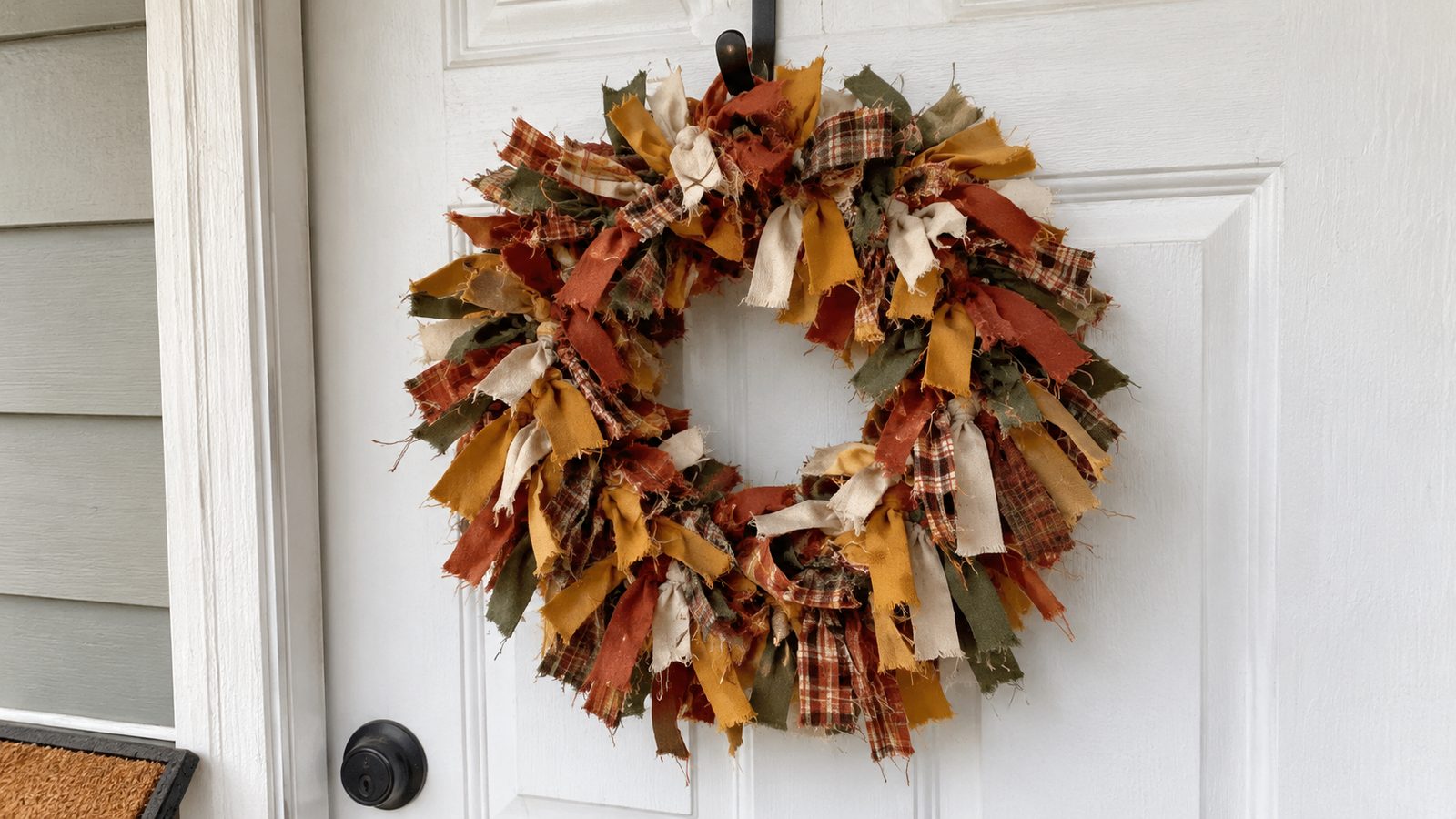
A rag wreath is a wire wreath frame buried under a few hundred short strips of cotton until no wire shows and the whole thing looks like a shaggy fabric puff. Most people tie the strips on one at a time. I sew mine. The strips get chained down the middle on the machine, gathered, and lashed to the frame in four runs, which turns a three hour job into two and gives a fuller wreath.
Skill level is true beginner: long basting and a few hand tacks.
The one thing that decides how good it looks is density. A thin rag wreath looks like a project that ran out of fabric. Plan on 250 to 300 strips for a 12 inch frame and do not stop early.
What you’ll need
- 12 inch wire wreath frame, the flat four-ring kind
- 1 1/4 to 1 1/2 yards of quilting cotton total, split across 3 to 5 fabrics
- All-purpose polyester thread, any color, about half a bobbin per 100 strips
- Universal 80/12 machine needle
- Hand-sewing needle, size 7 sharp, and strong thread, or 26 gauge floral wire, for lashing
- Rotary cutter, mat, and a 6 x 24 inch ruler, or sharp scissors
- One 2 x 12 inch strip of cotton, or 14 inches of 5/8 inch grosgrain ribbon, for the hanging loop
- Lint roller and a couple of binder clips
| Piece | Cut size | Qty |
|---|---|---|
| Long tear strip (before crosscutting) | 1 inch x width of fabric | about 43 |
| Wreath strip, 12 inch frame (sewn or tied) | 1 x 6 inches | 250 to 300 |
| Wreath strip, 14 inch frame | 1 x 6 inches (or 1 x 7) | 350 to 400 |
| Wreath strip, flannel on a 12 inch frame | 1 1/4 x 6 inches | 200 to 240 |
| Hanging loop | 2 x 12 inches | 1 |
Fabric, yardage, and tearing versus cutting
Quilting cotton is the fabric. It tears clean, frays just enough, and has enough body that the strips stand up instead of flopping. Homespun plaid is my favorite because it is yarn-dyed, so no wrong side shows. Flannel makes a softer wreath with fewer strips but sheds for a week. Skip knits, anything slippery, and anything thin like voile, because thin strips lie flat and never fluff.
Three to five fabrics is the sweet spot: one anchor color, two prints that share it, and one light neutral like cream or a tiny white dot. Check the wrong side of prints, since a pale back shows on half the strips.
The math for a 12 inch frame: a 1 inch strip torn selvage to selvage gives seven 6 inch strips. Three hundred strips is 43 long strips, which is 43 inches of fabric, so 1 1/4 yards total. A quarter yard each of five fabrics gives 315 strips with nothing wasted. Fat quarters give 54 each, which makes this a decent scrap fabric project if your scraps run bigger than 6 inches.
Tear the long strips instead of cutting them. A torn strip follows the crosswise grain of the fabric exactly, so it never goes wonky, and the torn edge has the soft fuzz that makes a rag wreath look like a rag wreath. Tearing 43 strips takes ten minutes, cutting them thirty. I only use the rotary cutter to crosscut the long strips into 6 inch lengths.
No prewashing. The wreath never gets washed, and the sizing in unwashed cotton helps the strips stand up. Press the yardage once if it is creased, then leave the torn strips alone.
Tear and cut the strips
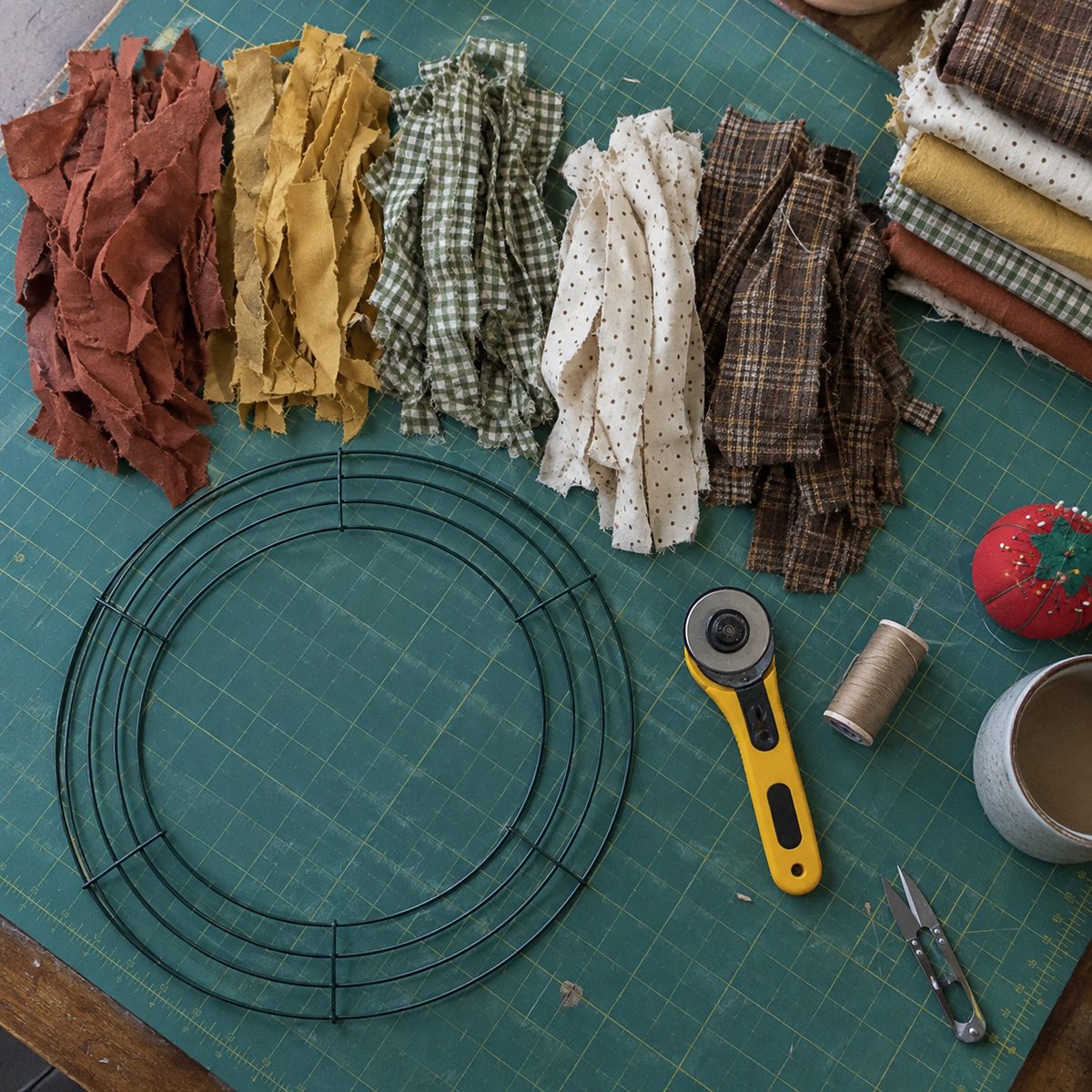
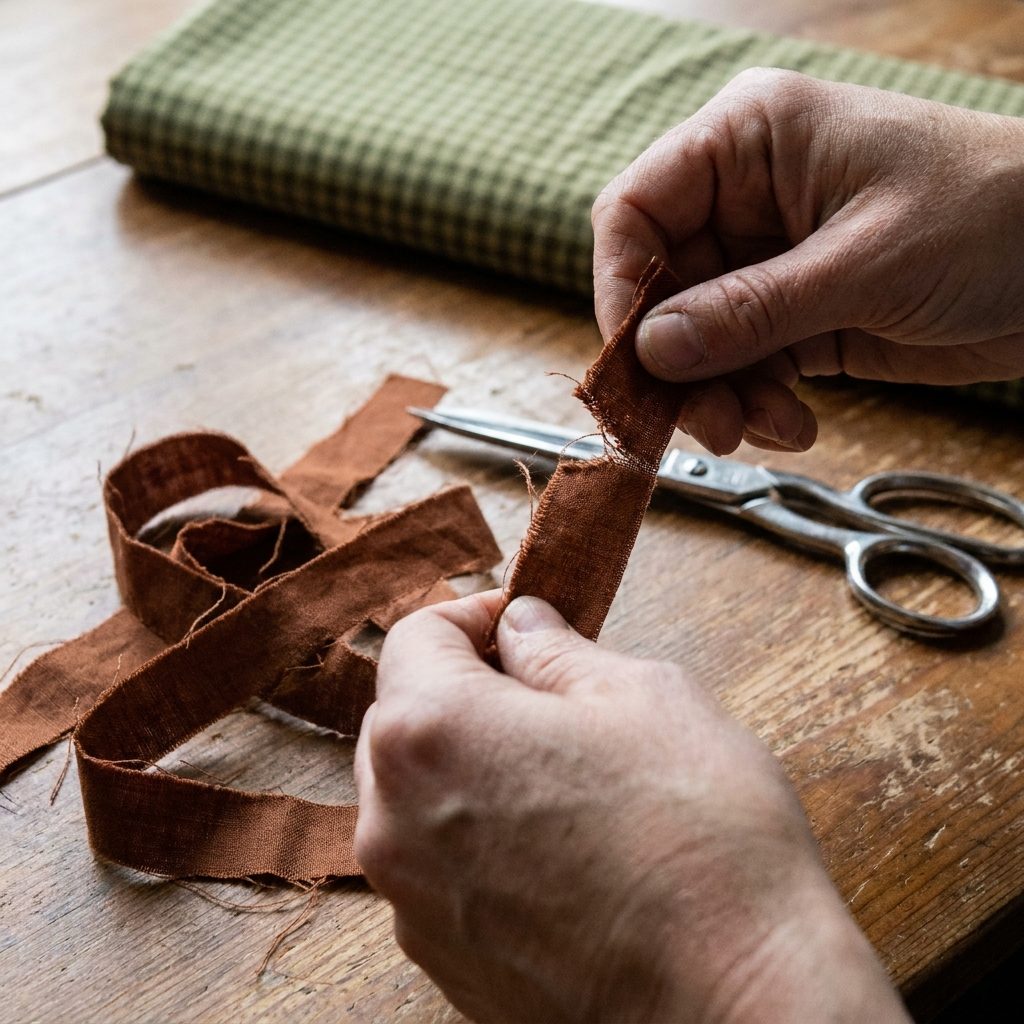
- Cut off the selvage on one side so the first tear starts clean. Snip 1/2 inch in from that edge, 1 inch down from the top, grab both sides, and rip across the full width. Tear fast and firm, since a slow tear wanders. The first strip off a bolt end is usually wobbly, so bin it.
- Keep snipping and tearing at 1 inch intervals until you have about 43 long strips. Pull off the long loose threads from each torn edge but leave the fuzz.
- Stack six to eight long strips, line up one end, and rotary cut 6 inch lengths down the stack. Sort the short strips into one pile per fabric so you can rotate colors as you sew.
- Count. Three hundred strips in piles of 50 looks like less than it should. If the piles look generous, you are probably under.
Chain the strips down the middle on the machine
This is the part that replaces 300 knots, and it runs about 20 minutes per 100 strips.
- Set the stitch length to 4 mm, or the longest your machine has, with a universal 80/12 needle and all-purpose polyester thread top and bobbin. Drop the upper tension by one number so the bobbin thread pulls easily later. This is a basting stitch, loose and long.
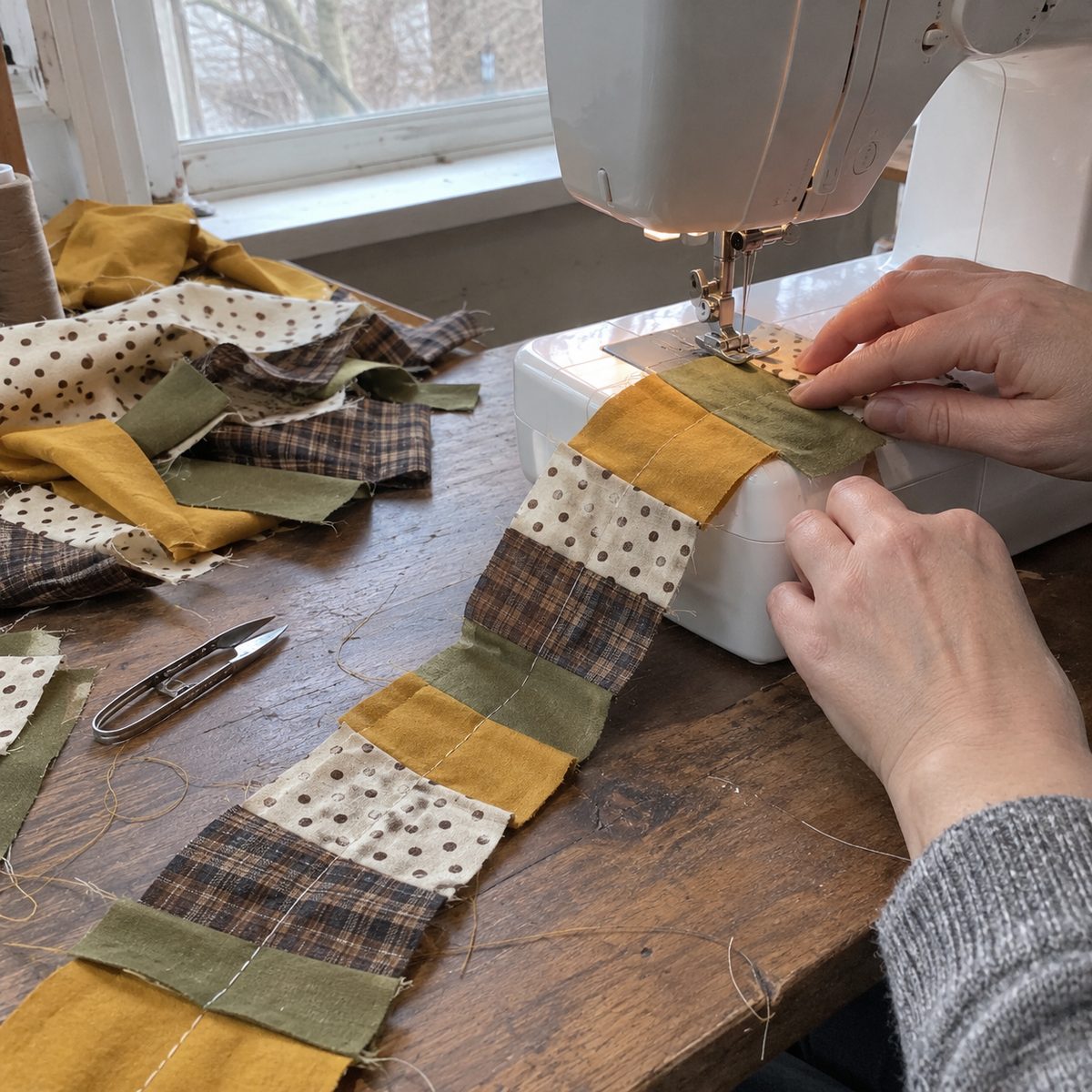
- Lay the first strip right side up crosswise under the foot so the needle comes down 3 inches from each end. Pull the thread tails to 6 inches, do not backstitch, and stitch across the 1 inch width.
- Before the needle leaves the first strip, slide the next one in with its long edge overlapping by 1/4 inch and keep stitching, alternating fabrics as you feed. The chain should look like a long centipede: one stitched spine with 3 inches of fabric fanning out to each side.
- Stop at 90 strips, pull the chain out, and cut the threads with 6 inch tails. Make four runs: 90 strips for the outer ring, 80 for the next, 70 for the next, 60 for the inner ring. That is 300.
- Hold a run up to the light. Every strip should be caught by at least three stitches, or it pulls out when you fluff. Restitch over any weak spot.
Gather each run and lash it to the frame
- Hold the 90 strip run by the thread tails at one end, find the bobbin thread, and pull it while sliding the strips toward the far end. Stop at about 38 inches, the length of the outer ring. The strips should be crowded so the spine ripples and no gaps show. Tie the threads together at both ends to hold the gather.
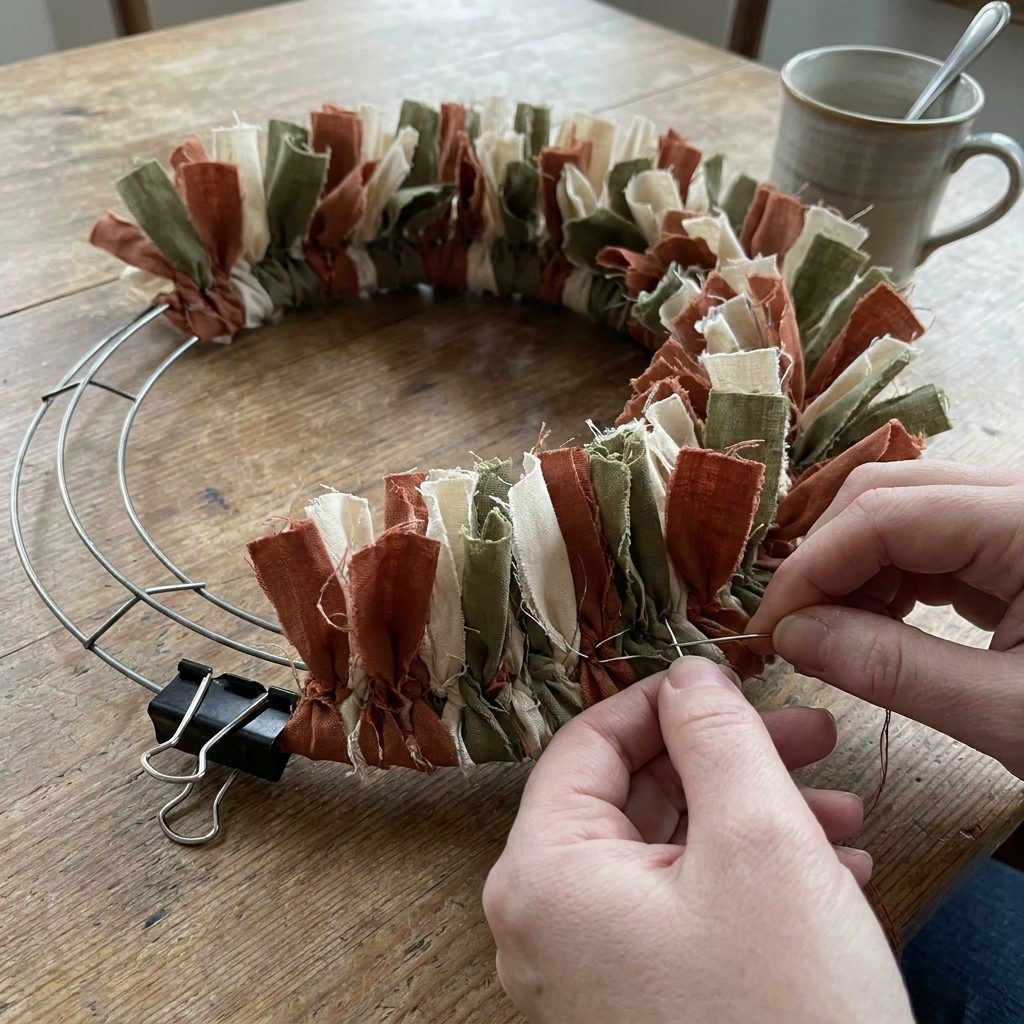
- Lay the gathered spine on top of the outer ring with the stitching line directly over the wire, so 3 inches of strip hangs off the outside and 3 inches points toward the center. Hold the start with a binder clip.
- Lash it down. My way is a hand needle with doubled strong thread: up through the spine, down over the wire, up through the spine again, pull snug, move along 1 inch, repeat. Or tie 26 gauge floral wire to the ring and spiral it around spine and wire every inch. Wire is faster, thread hides better. Either way the spine should hug the wire and the strips should spring up on both sides like a bottle brush.
- Back at the start, overlap the two ends of the run by 1 inch and lash through both. The outer ring should now be a complete shaggy circle with no bare wire showing.
- Gather and lash the 80 strip run to the next ring in, then 70, then 60 on the inner ring, sizing each gather to its ring first. When the inner ring is done the center hole will be nearly closed and the frame invisible from both sides.
The no-sew tie method, and when to use it
Tying is the classic way and needs nothing but strips and a frame. It takes about 3 hours for 300 strips, but it travels, and it is how I patch a thin spot on a sewn wreath.
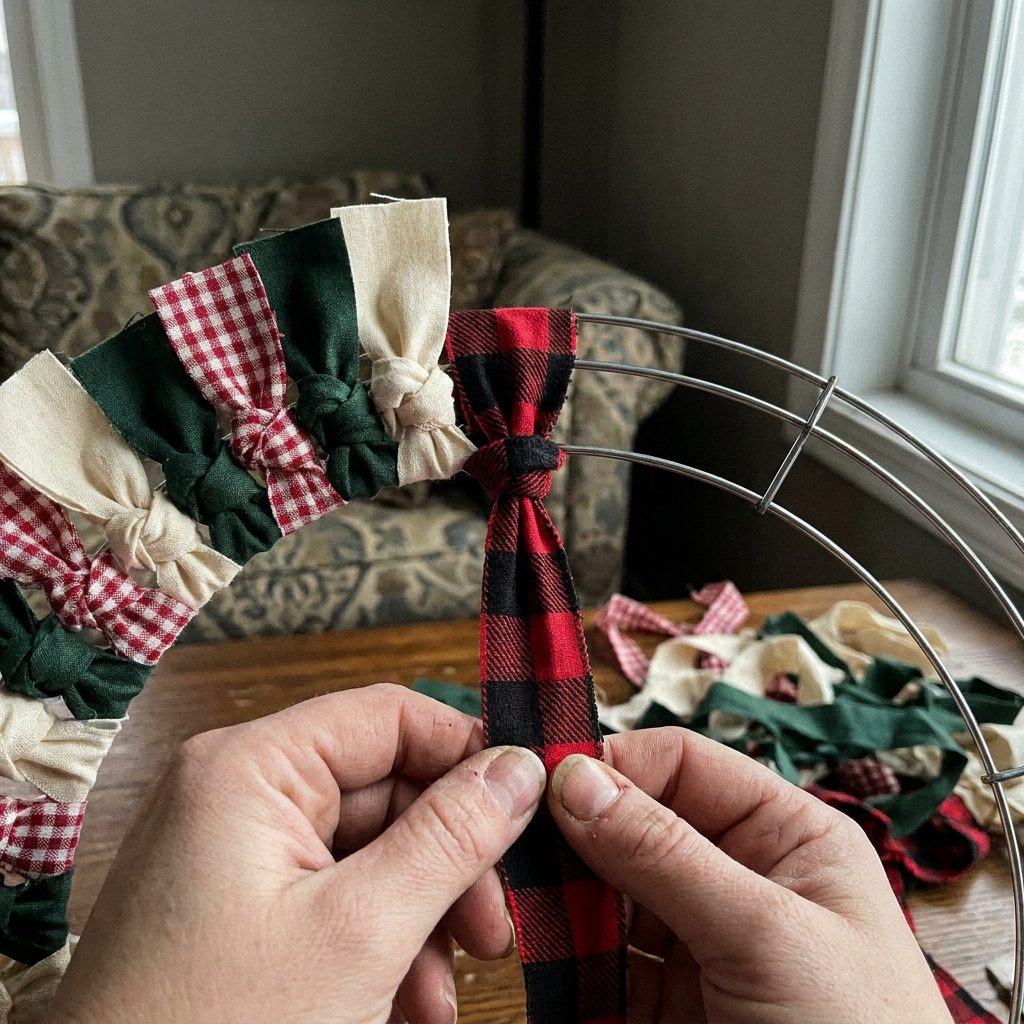
- Lay a strip under the outer ring, centered so 3 inches sticks out on each side. Bring both ends up and tie a single overhand knot, pulled tight against the wire. A single knot holds in cotton, and doubles sit up tall and eat length.
- Tie the next strip beside it in a different fabric and shove the two knots together. Every ten knots, push the whole row back toward the start to pack it. No wire should show between knots.
- Work in rotation around all four rings so the colors spread evenly, about 75 strips per ring.
- When the frame is full, turn it over. The back will be a mat of knots, which is normal. Flip it back and move on to the loop.
Hanging loop, fluff, and trim
- Make the loop from the 2 x 12 inch strip: fold the long edges in to meet at the center, fold in half again for a 1/2 inch tape, and topstitch both edges at 2.5 mm. Grosgrain ribbon skips this step.
- Turn the wreath until the best balance of color sits at the bottom, since that is where eyes land. Pass the tape around both the outer ring and the second ring at the top and tie a square knot on the back, leaving a 3 inch loop. Two rings keep the wreath from tipping forward on a door hook.
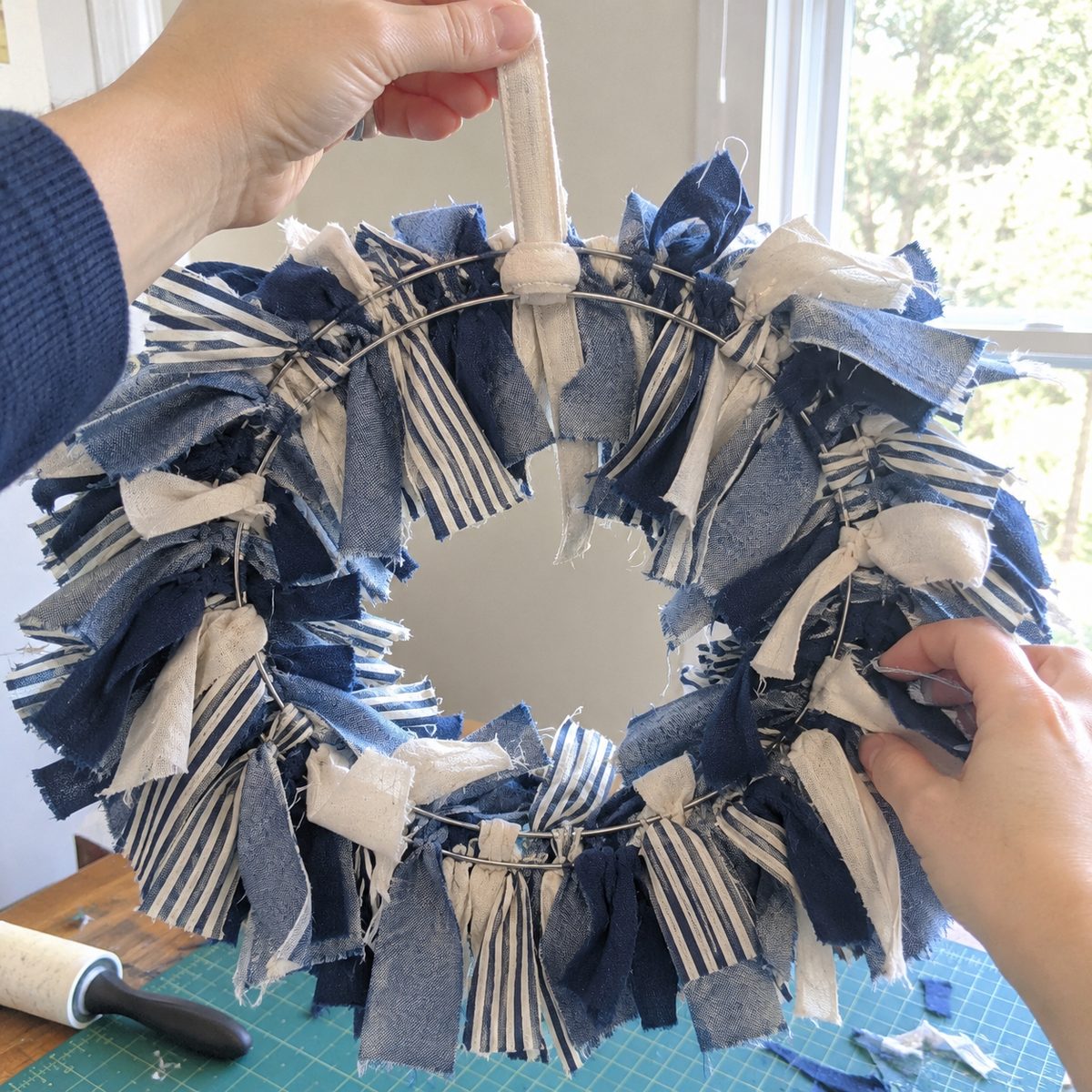
- Hang it and fluff. Comb the strips outward from the center with your fingers, then inward from the outside, then give it a hard shake. Rotate a quarter turn and repeat. The strips should point in every direction, including straight at you, and the wreath should look a third bigger than it did on the table.
- Trim only the strays. Any strip that sticks out more than 1/2 inch past its neighbors gets snipped on an angle. Do not even up the lengths, because a sheared rag wreath looks like a doormat. A 12 inch frame finishes around 17 inches across.
- Lint roll both sides, then stop trimming. It will shed for a week and settle.
Fixes for the things that go wrong
Wire shows through, or there are bald patches
The run was gathered too loosely, or you ran short on strips. Tear a dozen more strips and tie them straight onto the wire at the bald spot. Once it is fluffed nobody can tell a tied strip from a sewn one.
The strips lie flat and limp instead of standing up
The fabric is too soft or too thin, or you pressed the strips. Put the whole wreath in the dryer on air only, no heat, with a damp washcloth for 10 minutes. If it is still limp, tie a second layer of crisper cotton strips onto the outer ring.
The bobbin thread snapped while gathering
Gathering a long run from one end puts the whole load on one thread. Gather from both ends toward the middle, and never chain more than 90 strips in one run. If it snaps anyway, knot the thread at the break and gather the two halves separately.
Palettes, sizes, and batch making
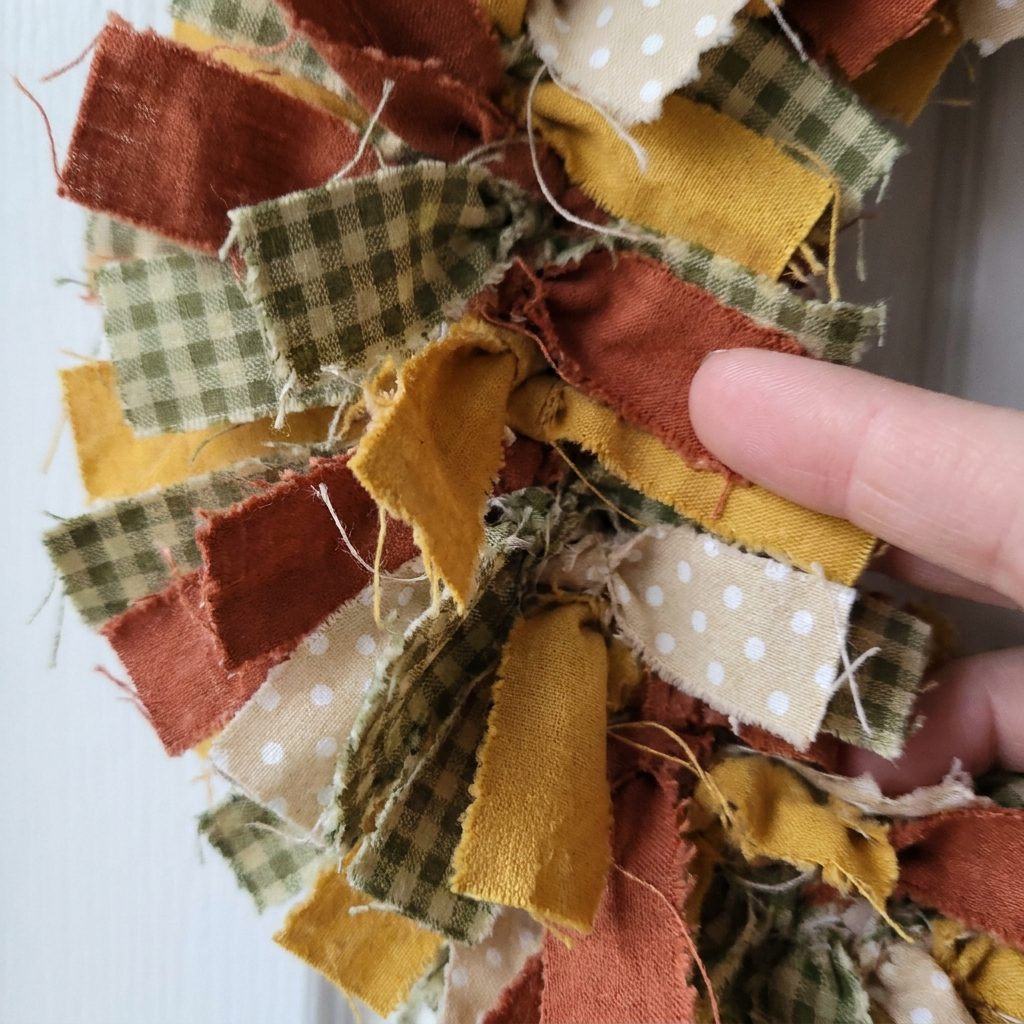
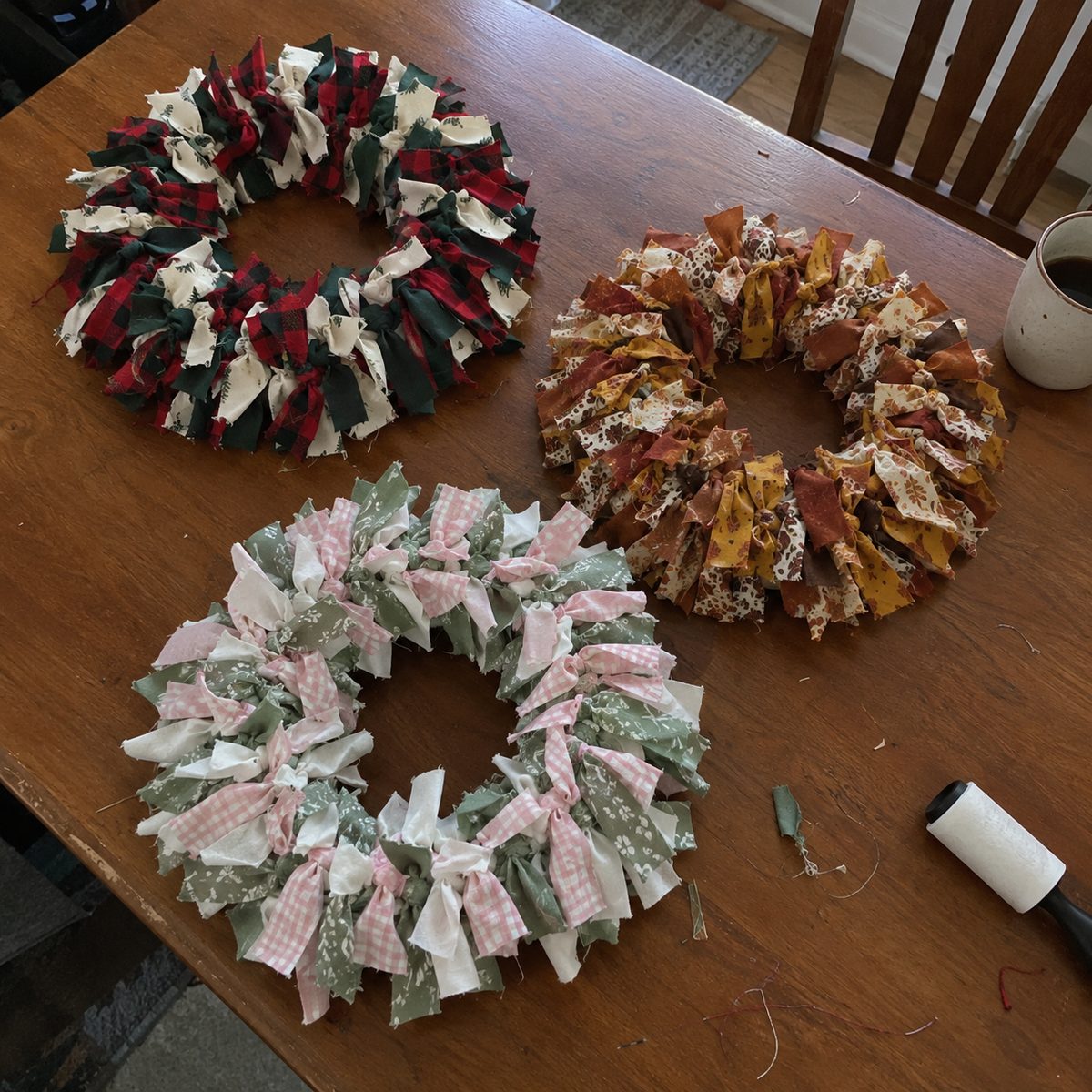
For fall I use rust, mustard, olive, and cream, with one homespun plaid pulling them together. It sits well with the acorns and pumpkins from the fall sewing projects list.
For Christmas, red and black buffalo check with cream and forest green is the one everyone asks about. Red and green is the oldest pairing because door wreaths started out as evergreen, and it reads as Christmas from the street. A 6 inch frame with 1 x 4 inch strips makes a tree ornament, and the mini fabric wreath ornament is a flatter take on the same idea. The rest of my Christmas sewing projects go with either.
For an everyday wreath that stays up all year, go navy and white ticking, chambray, and unbleached muslin. Pale pink gingham, white, and sage makes a nursery door wreath.
A 14 inch frame needs 350 to 400 strips and about 1 3/4 yards. For gifts, make three at once: tear all the fabric in one sitting, chain all the runs in another, then lash one wreath per evening.
Frequently asked questions
How many strips does a 12 inch rag wreath need?
Between 250 and 300 strips at 1 x 6 inches, which is 1 1/4 yards of cotton. Flannel is fatter, so 200 to 240 strips cover the same frame. With only 200 strips, cover three rings instead of four and gather each run tighter.
Can I wash a rag wreath?
Not once it is on the frame. The wire rusts and the strips tangle. Shake it outside, run a lint roller over it, or vacuum it with the brush attachment on low. For a wreath outside a storm door, pick darker fabrics, since cotton fades in a month of direct sun. Store it flat in a box.
Is the sewn version really faster than tying?
About an hour faster for 300 strips. Chaining takes an hour, gathering 10 minutes, lashing 40 minutes. Tying 300 knots takes most people 3 hours, and the sewn wreath is denser too. Tying wins on the couch or in a group with one machine.
Should the strips be 6 or 8 inches long?
Six for a 12 inch frame. Eight inch strips give a bigger, floppier wreath that finishes around 20 inches and needs about 1 3/4 yards. They hide the frame more easily, so 8 inches is the better choice when you are short on strips. Anything over 8 inches droops.
A thin rag wreath never fluffs up into a full one. Tear a few more strips than you think you need, pack the runs tight, and this one will hang on the door for years.