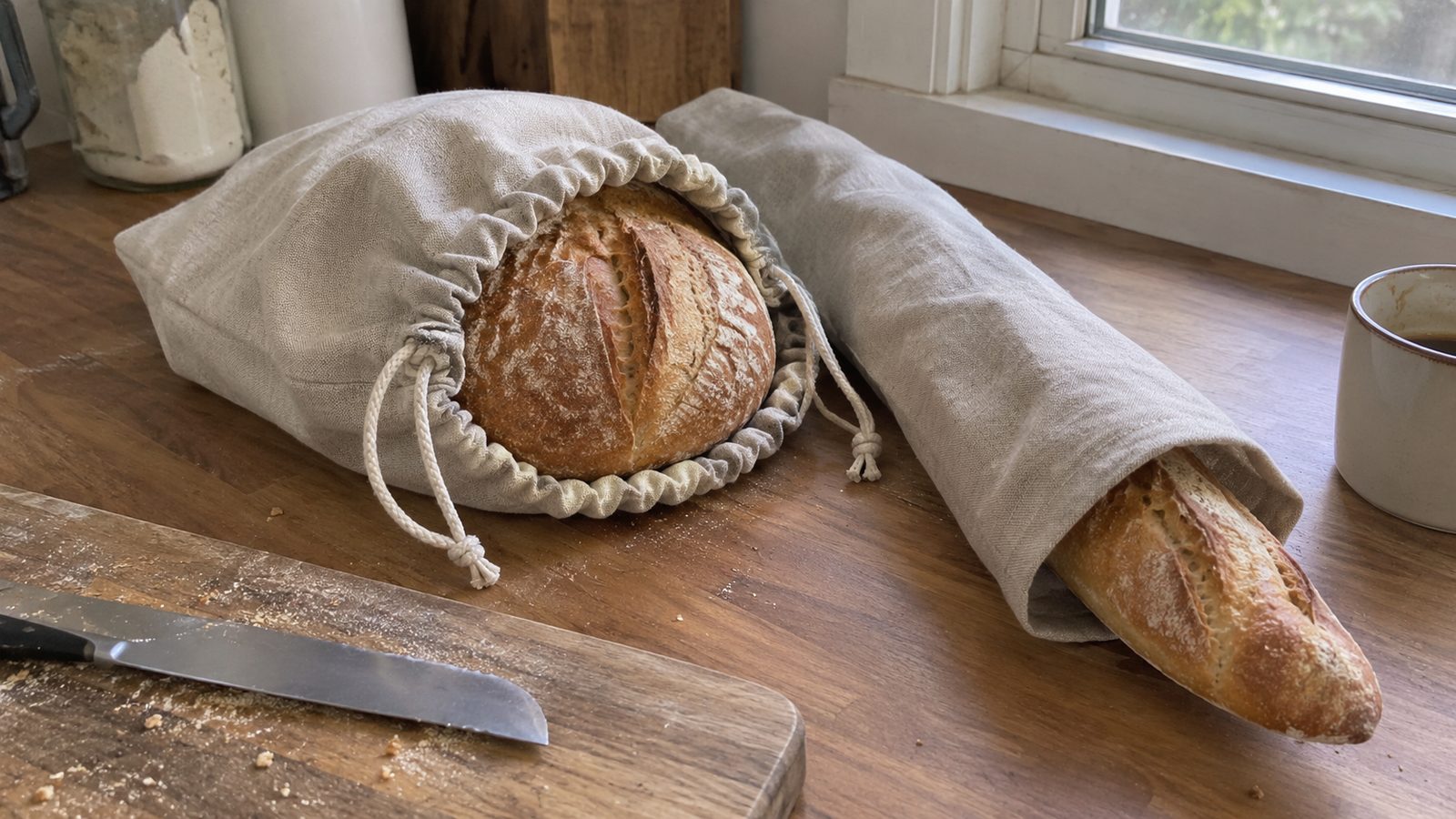
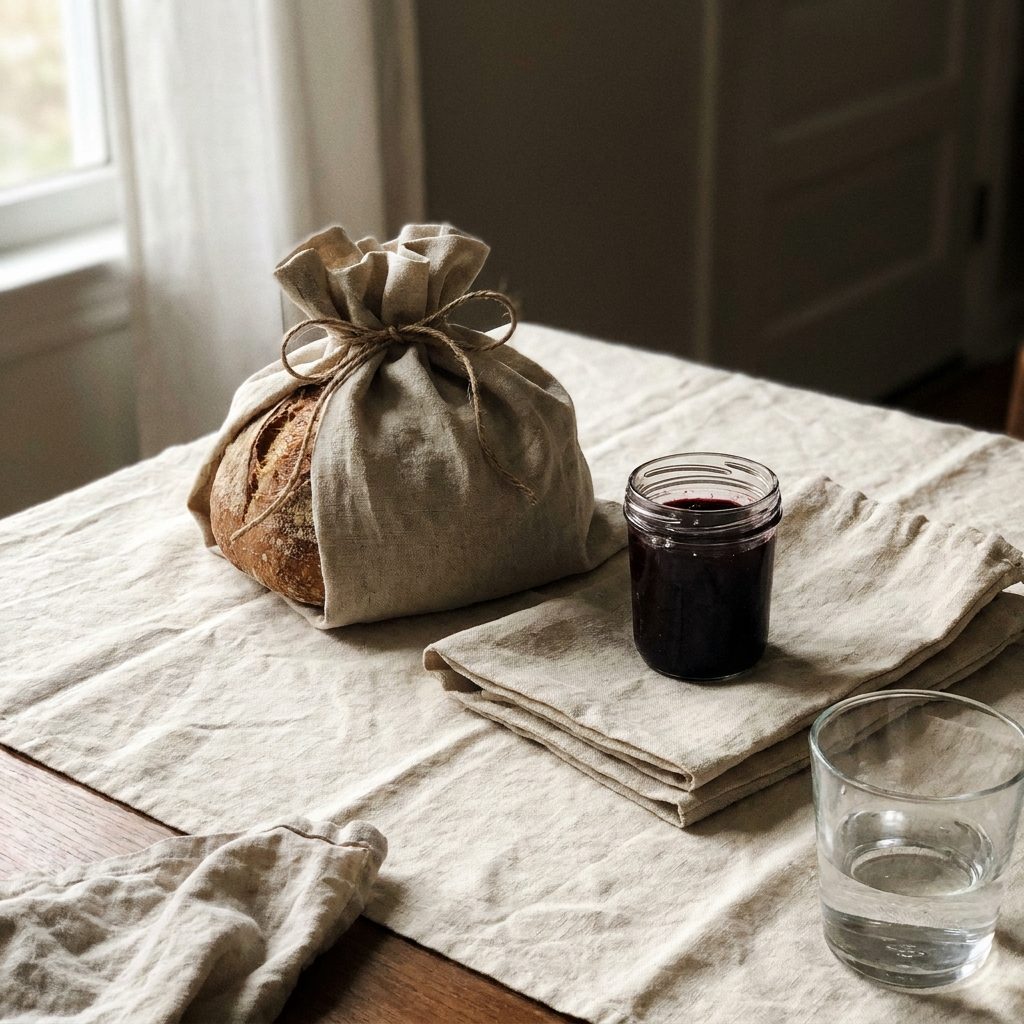
A drawstring bread bag is a flat linen or cotton sack with a cord at the top, cut to fit one loaf. The cord pulls shut and the crust stays crisp for a day or two instead of going soft in plastic. Mine double as produce bags on market day.
One bag takes about an hour, the pair an hour and a half. Confident beginner level: straight seams only, but the casing has to be measured, not guessed.
What makes it come out well is the French seam. Every raw edge ends up sealed inside a second seam, so nothing frays into the bread.
What you’ll need
- 1 yard of medium-weight 100% linen (about 5.3 ounces, 54 inches wide) or heavier unbleached cotton muslin (4 to 5 ounces, 44 inches wide). One yard makes both bags.
- One spool of 100% cotton 50 weight thread in natural or white (all-purpose polyester is fine too)
- 4 1/2 yards of 3/16 inch cotton cord, or 1/2 inch cotton twill tape, for two bags with double drawstrings
- Universal machine needle, 90/14 for linen or 80/12 for muslin
- Bodkin or a large safety pin
- Rotary cutter, ruler and mat, or scissors and a yardstick
- Water-soluble marker or chalk pencil
- Pins or clips, and an iron with steam
| Piece | Cut size | Qty |
|---|---|---|
| Boule bag body (finished about 13 by 15 inches) | 14 1/4 by 17 1/2 inches | 2 |
| Boule drawstring | 40 inches of cord or tape (38 inches for a single cord) | 2 |
| Baguette bag body (finished about 7 by 26 inches) | 8 1/4 by 28 1/2 inches | 2 |
| Baguette drawstring | 28 inches of cord or tape (26 inches for a single cord) | 2 |
| Sandwich loaf bag, optional (finished about 10 by 14 inches) | 11 1/4 by 16 1/2 inches | 2 |
The cut sizes already include 5/8 inch per French seam and 1 3/4 inches at the top for the casing.
Fabric, cord, and prep
Use 100% linen if you can, medium weight at about 5.3 ounces, in natural or oatmeal. It is the traditional bread cloth for a reason: linen wicks moisture and dries fast, so the crust does not sweat and the washed bag dries in an hour. One yard makes both bags and they last for years.
The budget choice is unbleached cotton muslin, the heavier 4 to 5 ounce kind. The thin 2 ounce muslin frays badly in a French seam and does nothing for a crust. Cotton canvas at 7 ounces also works, but anything heavier fights you at the casing folds.
Skip polyester and blends. Polyester does not breathe, which puts you right back where the plastic bag was: a soft crust by morning and condensation inside. Skip the lining too. It is two layers trapping crumbs, and it takes twice as long to dry. One layer of a natural fiber is the whole point.
For the drawstring, 3/16 inch cotton cord is my pick. It knots well and washes with the bag. Half-inch cotton twill tape works too, but it twists inside the casing unless you press it after every wash. Avoid nylon paracord. It is slick and the knots creep loose.
Prewash twice, hot, no fabric softener, and tumble dry. Twice because linen can shrink 5 to 8 percent and the second wash takes out the sizing the first one leaves behind. The full routine is in why and how to wash fabric before sewing. Softener is the one thing to avoid. It coats the fibers, kills the wicking, and the bread smells like laundry.
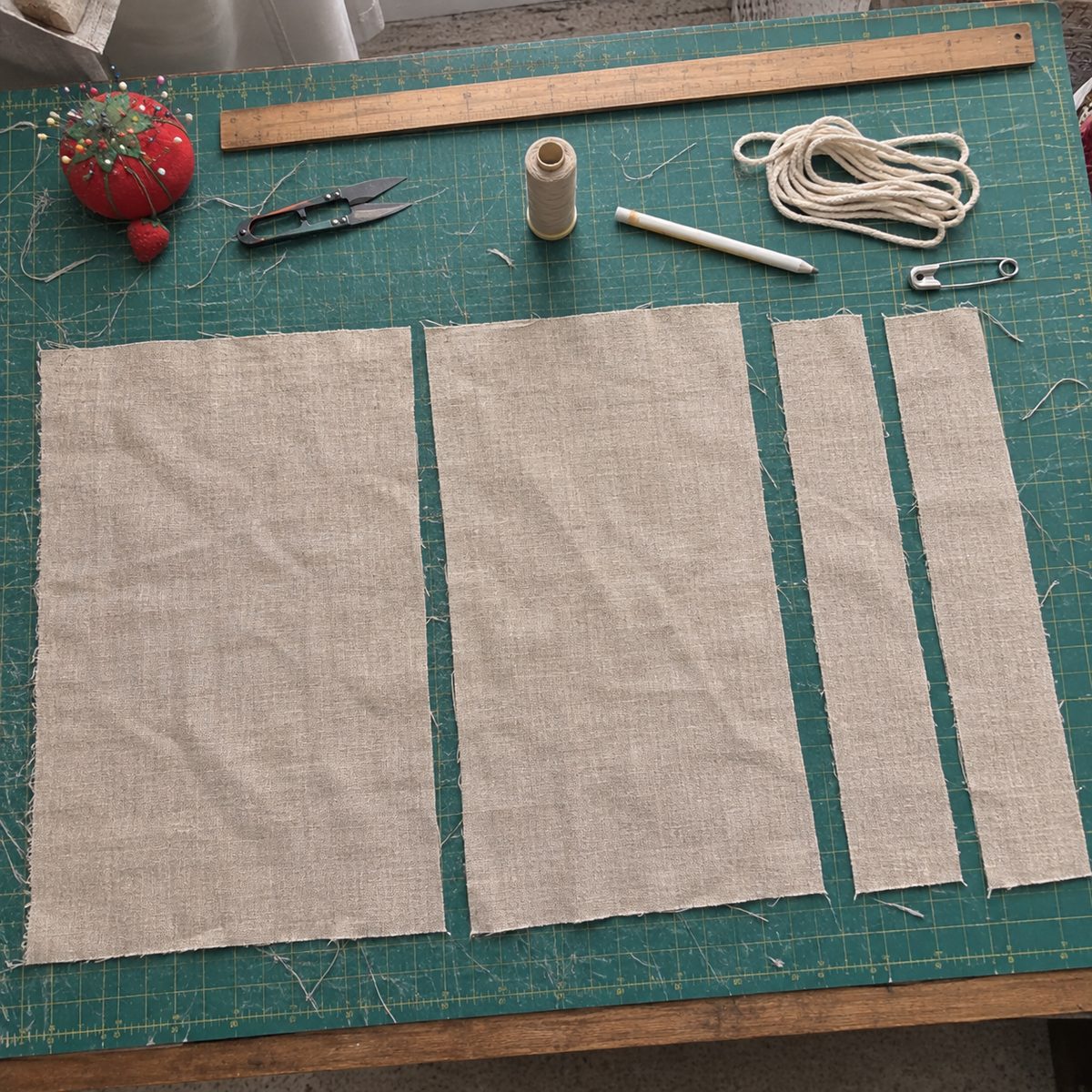
Press flat with steam and cut using the chart. On the wrong side of each piece, mark a dot 3 inches down from the top short edge on both long sides. Those four dots are where the side seams stop and the drawstring slots begin. Cut these alongside any other kitchen sewing projects in your pile.
Sew the French seams
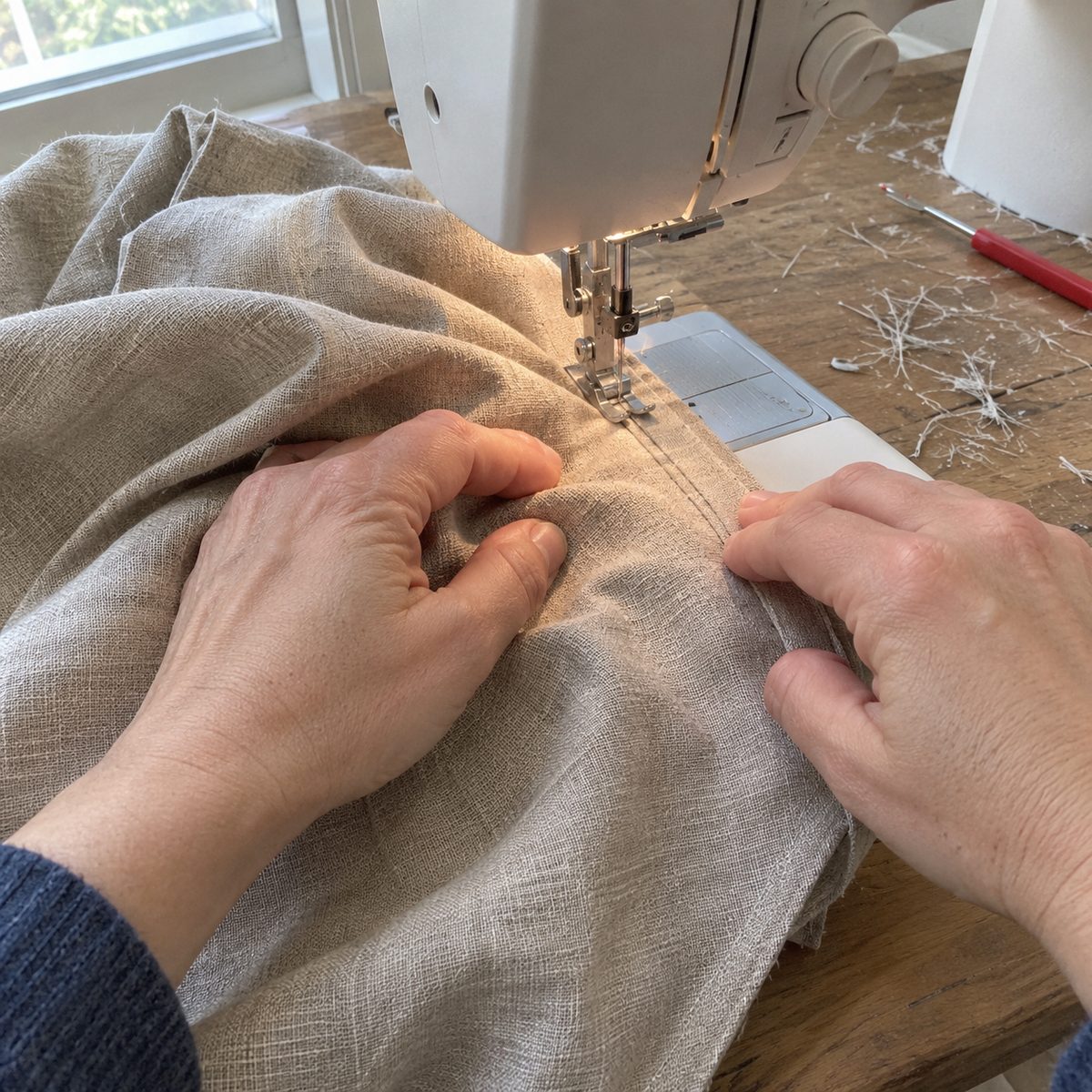
A French seam is sewn twice: once wrong sides together with a narrow allowance, then again right sides together so the first seam is wrapped inside the second.
- Lay the two body pieces wrong sides together, which feels backwards the first time. Pin the sides and bottom. Stitch length 2.0 for linen, 2.5 for muslin. Start at one 3 inch dot, sew down the side at 3/8 inch, pivot, across the bottom, pivot, and up to the other dot, backstitching at both dots. You now have a bag that is right side out with the allowances on the outside.
- Trim the allowance to a scant 1/8 inch from dot to dot. Do not trim above the dots. Clip the bottom corners diagonally. The trimmed edge should be an even strip with no loose threads longer than the allowance.
- Press the seam flat as sewn. Turn the bag wrong side out, roll the seam right out to the edge with your thumbs, and press it sharp. The stitching line should sit exactly on the fold with no lip of fabric past it.
- Sew the second pass 1/4 inch from the folded edge, dot to dot, stitch length 2.5, backstitching at both ends. On the inside you should see a neat 1/4 inch ridge. On the outside, a plain seam line with nothing fraying.
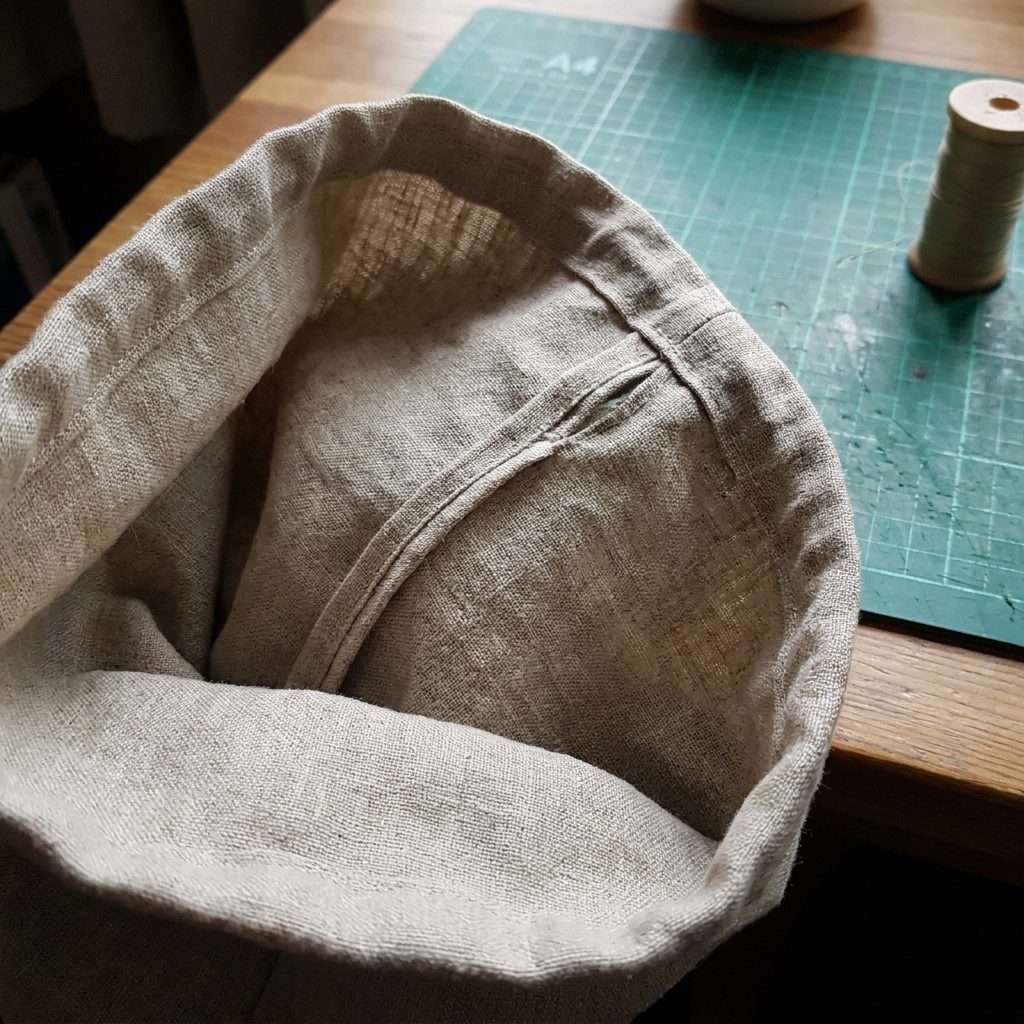
- Above the dots, the four side edges are still raw for 3 inches. Fold each one 1/4 inch to the wrong side, then 3/8 inch again so the fold lands on the seam line, and edgestitch it. Each slot edge now sits flush with the French seam below it.
Box the bottom corners
Boxing the corners gives the boule bag a flat base so a round loaf sits upright. Skip it on the baguette. The usual method, the one in my lined tote bag with boxed corners, cuts the triangle off and leaves a raw edge. Here the trick is to leave the triangle on.
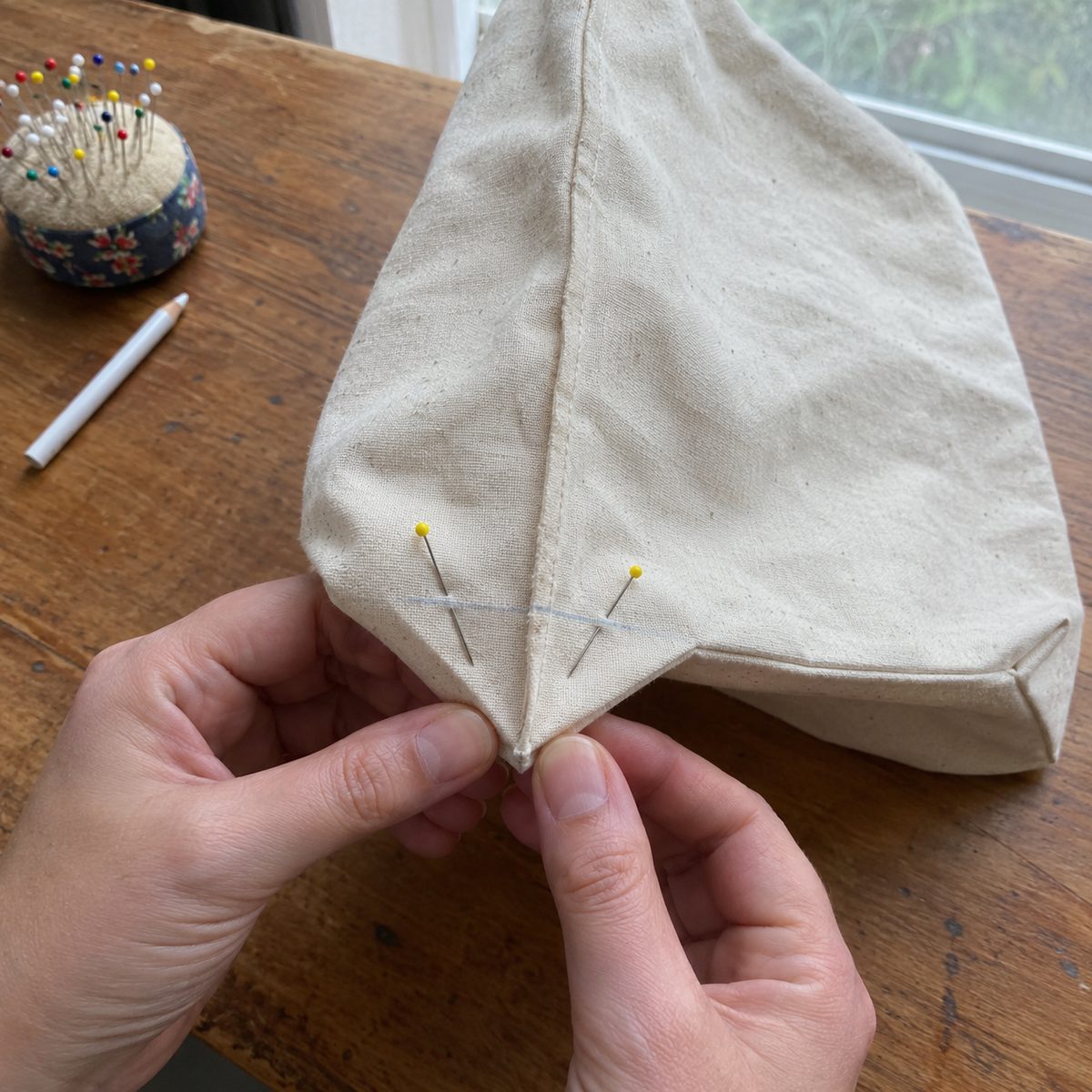
- With the bag wrong side out, pinch one bottom corner so the side seam lies directly on top of the bottom seam, forming a triangle. Press the two ridges in opposite directions so they nest.
- Measure 1 inch down from the point along the seam and draw a line straight across at that spot, about 2 inches long. Pin on both sides of the line.
- Sew on the line, backstitching at each end. Hand-walk the needle over the seam ridges if the machine stalls. You should have one straight 2 inch seam across the corner.
- Do not cut the triangle off. Fold it flat against the bottom of the bag and tack its point to the bottom seam ridge with four or five hand stitches. Repeat on the other corner. Turned right side out, the base is a flat 2 inch wide rectangle with every edge still sealed.
Fold and stitch the casing
The casing is a plain double fold, 1/2 inch then 1 1/4 inches, which leaves a channel a 3/16 inch cord slides through without binding.
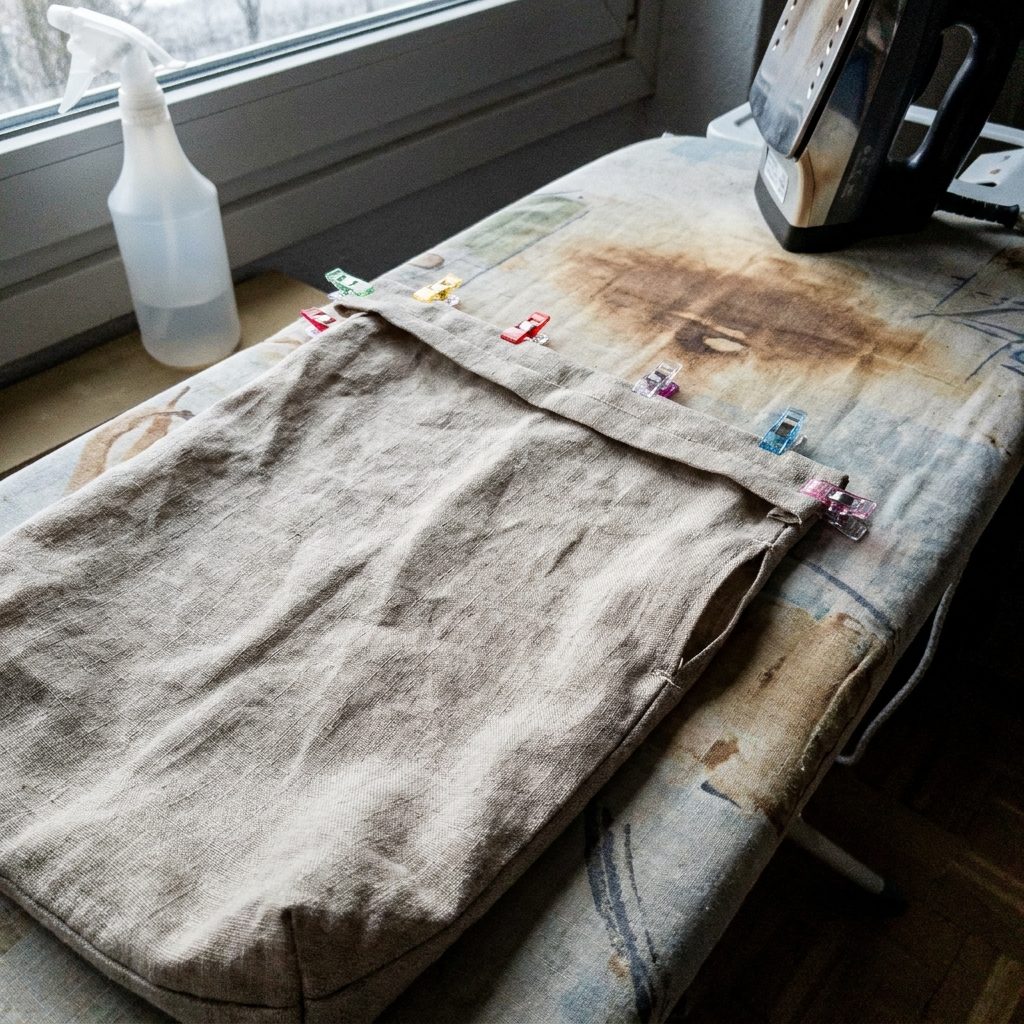
- Turn the bag wrong side out. Press the top raw edge 1/2 inch to the wrong side all the way around, then press it over again at 1 1/4 inches. The second fold should land at the top of the 3 inch slots, and the lower edge of the casing should just cover the backstitching where the seams stop. Pin or clip.
- Stitch 1/8 inch from the lower folded edge all the way around, stitch length 3.0, starting at a side seam and overlapping the start by 1/2 inch. Keep the opening spread flat so you do not catch the far side. You should have one continuous line of stitching and a clean 1 1/4 inch slot at each side seam.
- An optional second row 1/8 inch below the top fold stops the cord rolling over the edge. I do it on linen and skip it on muslin.
- Turn right side out and press. Both slots should be open, the same height, and hemmed with no raw threads inside.
Thread the drawstrings
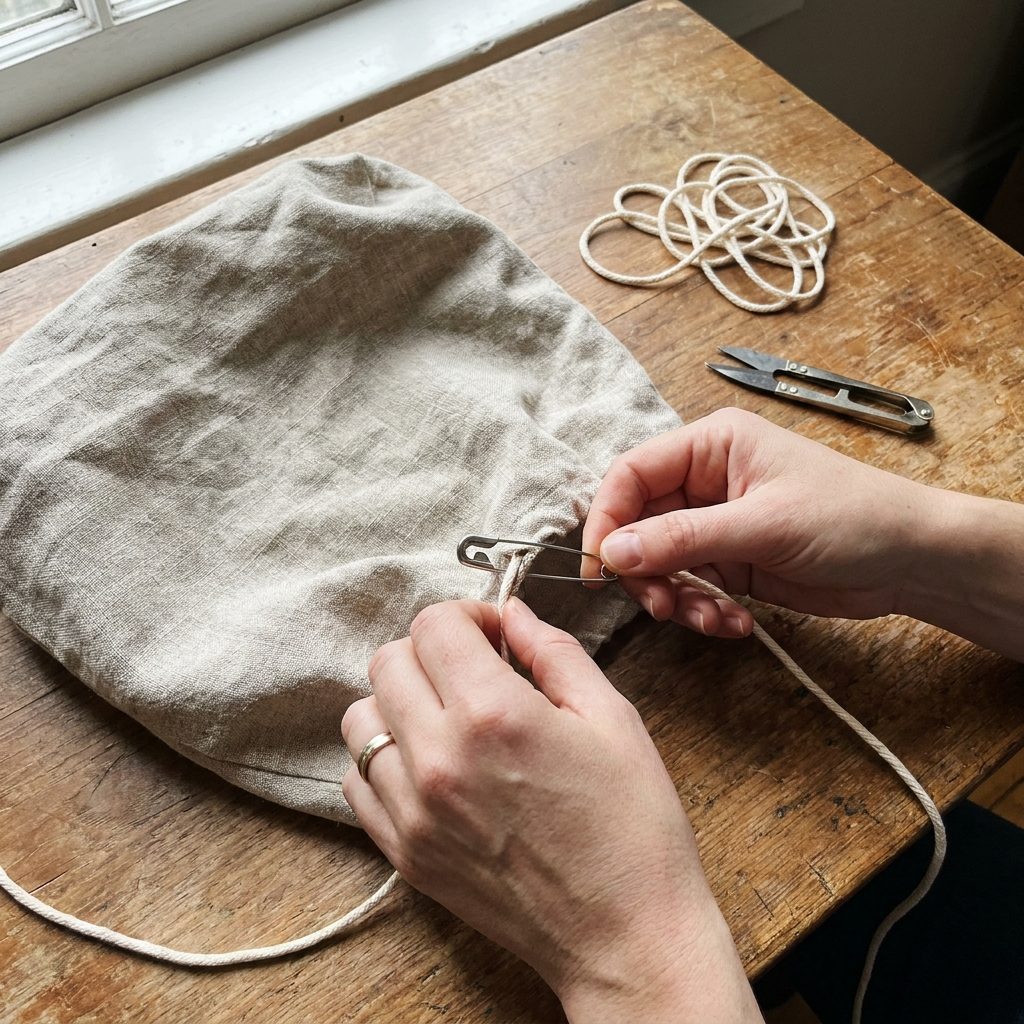
- Cut two cords to the chart length. Pin the safety pin through one end of the first cord, 1/2 inch from the tip.
- Push the pin into the left slot, work it all the way around the casing, through the right slot and back out the left. Even up the tails and tie them in an overhand knot 1 inch from the ends. You should have a loop of cord with both tails coming out the left side.
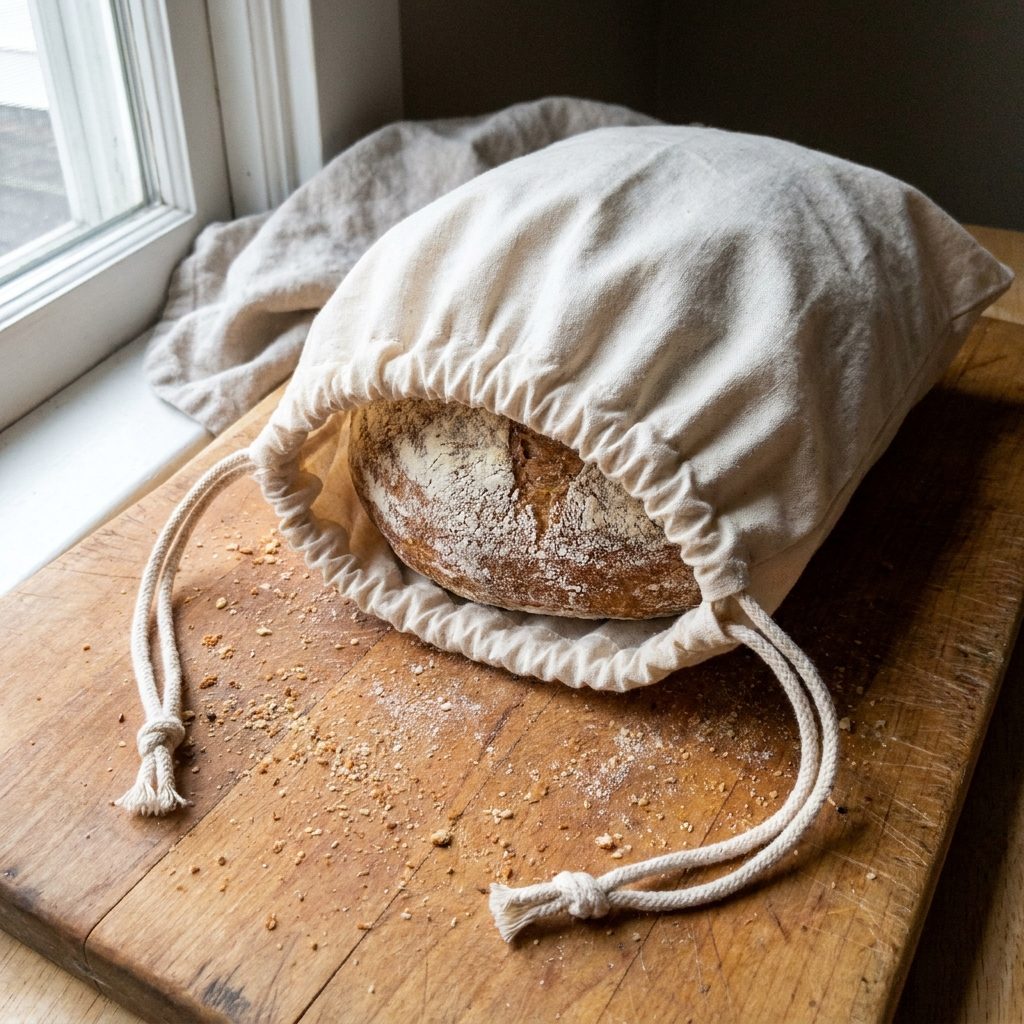
- Thread the second cord from the right slot, around, and out the right slot. Knot it. Pull the two knots away from each other and the bag cinches shut from both sides at once, the top gathering into an even ruffle.
- For a single cord, thread one length in and out the left slot and knot the tails. It closes from one side and leaves a tail to carry by, which I like on the baguette.
- Pull the cords open, give the bag a last press, and put a loaf in. The cord should slide freely with no catching at the slots or seam ridges.
Fixes for the things that go wrong
Little threads poke through the finished French seam
The first pass was trimmed wider than 1/8 inch, or the edge frayed between trimming and the second pass. Pick out the second seam, retrim, and resew at 3/8 inch instead of 1/4 to swallow the whiskers. You lose 1/8 inch of width and nobody will notice.
The cord jams at the side seam
The French seam ridge inside the casing is standing up and the bodkin is hitting it. Reach in the slot, press the ridge to one side with a fingernail, and push the pin past. If it jams every time, the side seam ran past the 3 inch dot and the slot is too short. Open the top 1/4 inch of that seam and resew the slot edge.
The casing stitching caught the back of the bag
You sewed through both layers and the bag will not open, a common mistake on the narrow baguette bag. Unpick only the stuck section, slide a ruler inside to keep the layers apart, and resew that stretch, overlapping the good stitching by 1/2 inch at each end.
The boxed corners are two different sizes
You measured from the raw corner on one side and from the seam point on the other. Always measure along the seam line from the point where the side seam meets the bottom seam. Unpick the bigger one and resew it to match the smaller.
Variations and a gift set
Resize for whatever you bake. The sandwich loaf bag in the chart fits a 9 by 5 inch pan loaf, and a 10 by 10 inch bag holds a dozen dinner rolls. The math is the same for any size: finished width plus 1 1/4 inches, finished height plus 2 3/8 inches.
Fabric swaps are mostly about color, since the fiber should stay linen or cotton. Natural linen with a red ticking stripe cord looks right on a farmhouse counter. Oatmeal linen with a navy cord is the one I give to people with modern kitchens. Save printed quilting cotton for a fabric gift bag, since it is thin for this job.
The gift set is a boule bag with a fresh loaf inside, the cords tied in a bow, and a tag with how to store it. Add a jar of jam and it becomes a housewarming gift that actually gets used. For a batch, cut everything first and chain-sew each pass on every bag before moving on. Six bags take about three hours.
Frequently asked questions
How long does bread stay fresh in a cloth bread bag?
A crusty loaf keeps a crisp crust for one to two days in a linen bag on the counter, far better than plastic, where it goes soft overnight. After day two the crumb firms up, and keeping the cut side down on a board inside the bag slows that. A soft sandwich loaf actually dries faster in cloth, so for that bread the bag is about looks.
How do I wash a linen bread bag?
Shake out the crumbs after every loaf and wash every two or three loaves. Hot water, regular detergent, no softener, and no bleach on linen since it weakens the fibers. Pull the cords fully open first so the casing does not gather and stay damp. Tumble dry or hang it.
Can I use a serger instead of French seams?
You can, and the bag will hold together fine. I stick with French seams for anything that touches food because serged edges shed short threads for the first dozen washes, and those end up on the loaf. If you serge, run a lint roller inside before the first use.
Does a bread bag need a lining?
No, and it is better without one. Bread needs air moving through the cloth, and every layer slows that down. A lining is also a hidden space where crumbs collect and moisture sits between washes. One layer of linen or heavy muslin with French seams is cleaner, dries faster, and takes half the fabric.
Once you have made the pair, the next loaf will go straight into a bag and the plastic will stay in the drawer. These are the kind of easy bags to sew that turn into a habit, and a stack of three in natural linen is a gift I never have to think about.