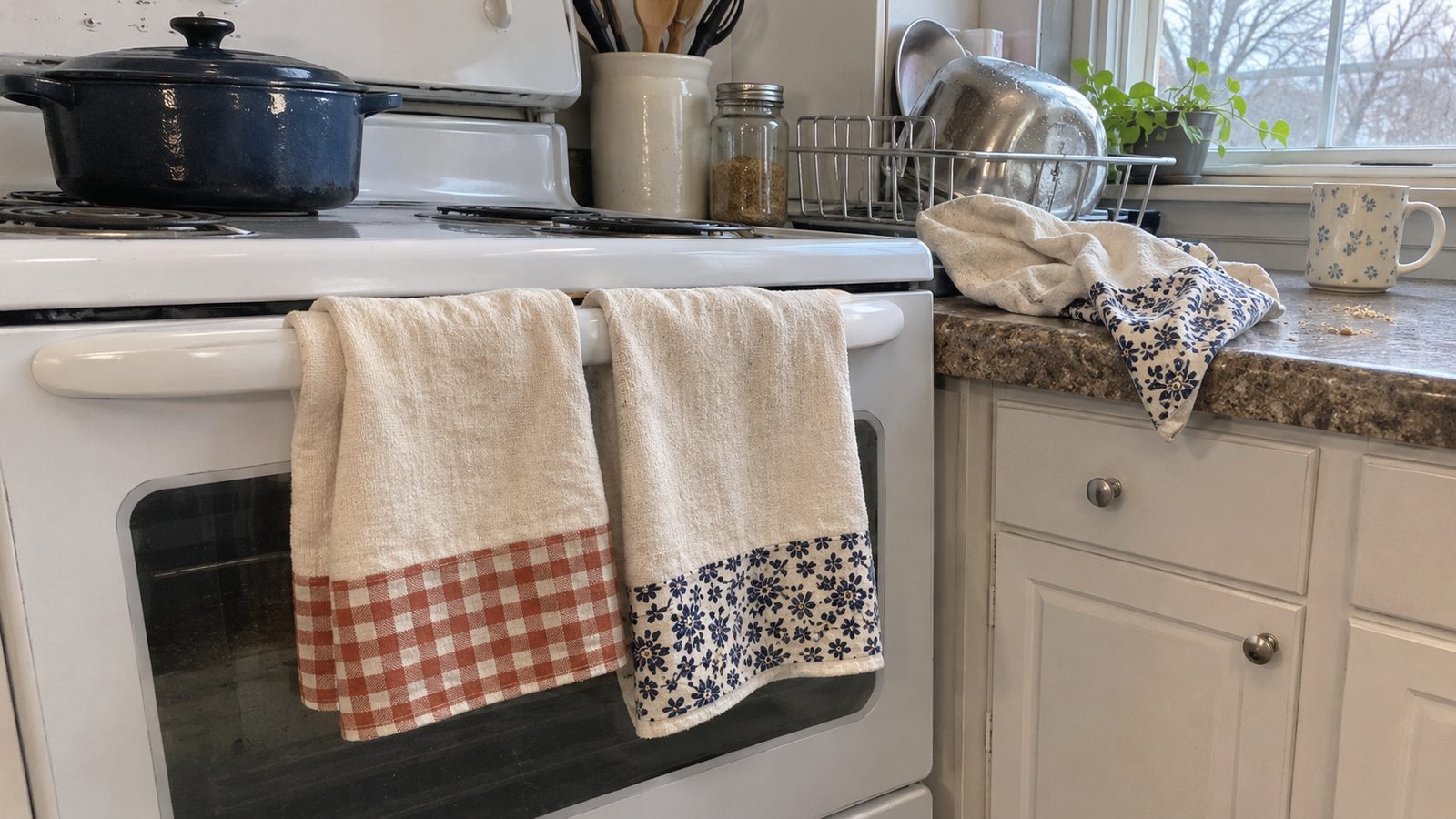
A tea towel is a flat rectangle of absorbent cotton or linen with a narrow hem on all four sides and, if you want it, a strip of printed cotton across one end and a loop to hang it by. The standard size is 18 by 28 inches. One takes about 40 minutes after prewashing. A set of six takes an afternoon.
This is a beginner project, because it is almost all pressing and straight stitching.
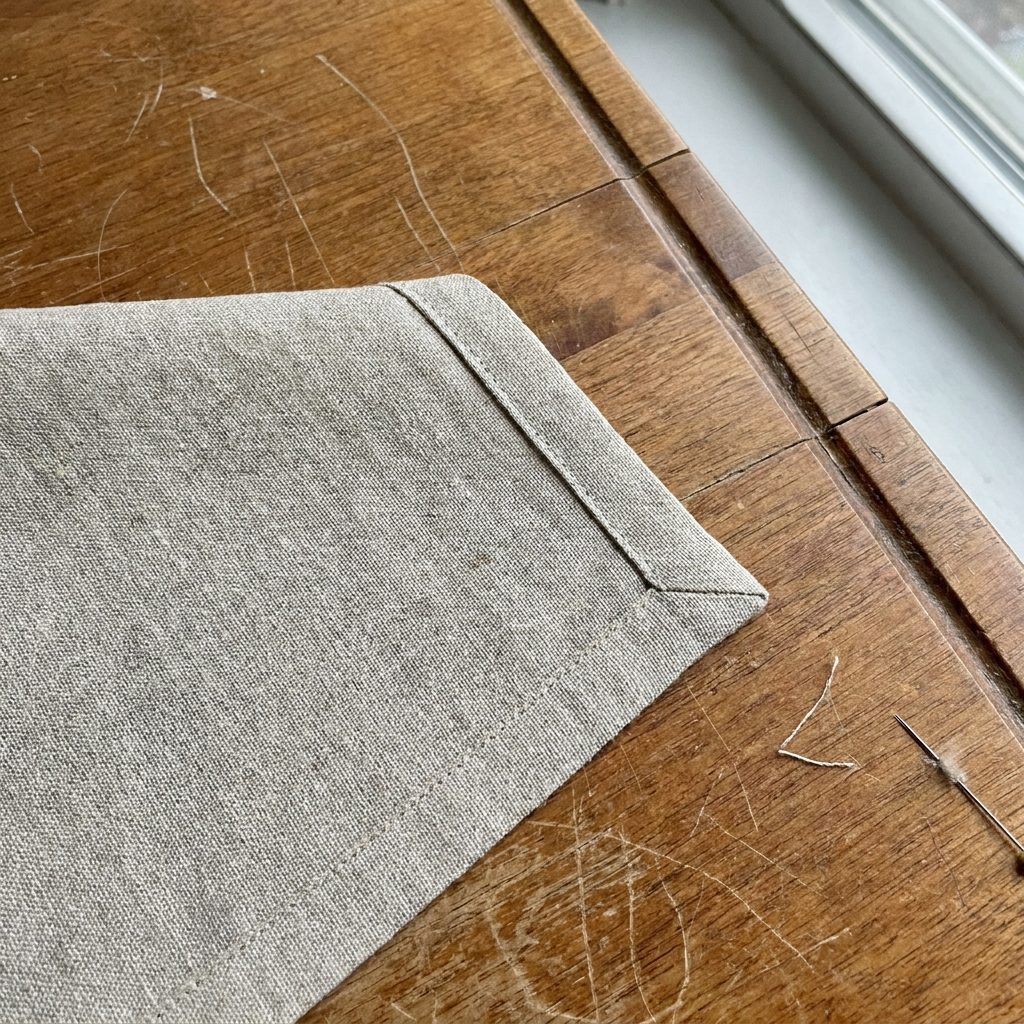
The thing that makes a tea towel look bought instead of homemade is the corner. A mitered corner that lies flat, with the stitching turning square at the point, is the whole skill. Everything else is a straight line.
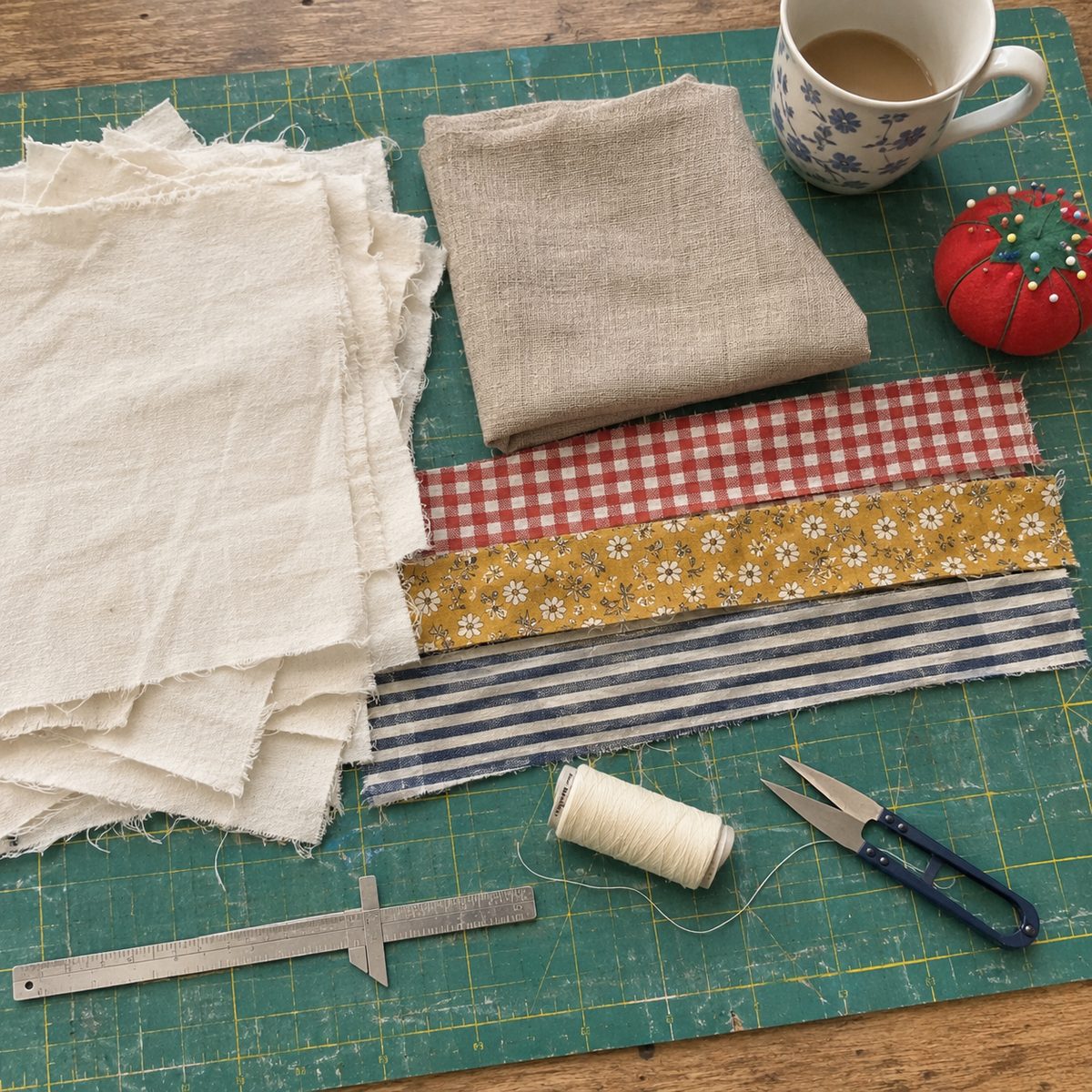
What you’ll need
- Toweling fabric, 20 by 30 inches per towel: flour sack cotton, linen, a cotton-linen blend, or huck toweling (2 to 2 1/4 yards of 58 to 60 inch fabric for six)
- Quilting cotton for the band, a 4 1/2 by 19 inch strip per towel, or 1/2 yard for six
- All-purpose polyester or 50 weight cotton thread, close in color to the toweling
- Universal needle, 80/12 for flour sack and linen, 90/14 for huck
- Iron, a spray bottle of water, and a hem gauge
- Rotary cutter and mat, or shears if you tear
- A 2 by 6 inch scrap or 6 inches of twill tape per hanging loop
| Piece | Cut size | Qty |
|---|---|---|
| Towel body, one towel (finished 18 by 28) | 20 by 30 inches | 1 |
| Band strip, quilting cotton | 4 1/2 by 19 inches | 1 |
| Hanging loop | 2 by 6 inches | 1 |
| Six from 2 yards (finished 17 by 28) | 19 by 30 inches | 6 |
| Six from 2 1/4 yards (finished 18 by 28) | 20 by 30 inches | 6 |
| Band strips for six | 4 1/2 by 18 inches (19 for the larger set) | 6 |
Six lay out three across and two down on 58 to 60 inch fabric. Two yards starts at 72 by 60 and comes out of a hot wash closer to 68 by 57, which is why that set cuts 19 wide. Buy 2 1/4 yards for the full 18.
Fabric: what works and what to skip
Flour sack cotton is my default: a thin, soft plain weave that dries fast, hems without bulk, and gets better with every wash, for under $8 a yard. Buy yardage, not pre-hemmed blanks, which are hemmed crooked more often than not.
Linen is the nicer towel and the better gift. It absorbs more than cotton, leaves no lint on glasses, and is stronger wet than dry, which is why it has always been the glass towel. Look for 5 to 6 ounces per square yard, $15 to $25. A cotton-linen blend is the sensible middle at about $12. Huck toweling, a cotton with a small honeycomb texture, scrubs well, wants the 90/14 needle, and hides wobbly topstitching.
Two to skip. Terry cloth is a bath towel. The loops catch on the presser foot and a mitered corner in terry is a lump the size of a thumb. Quilting cotton as the whole towel is the other common mistake. It looks wonderful on the bolt and absorbs almost nothing, because it is woven tight for quilts. Save it for the band.
Prewash everything, hot wash and hot dry, because that is how the towel will live. Flour sack cotton shrinks 5 to 8 percent the first time, close to 2 inches on a 30 inch cut. Linen loses 4 to 6 percent, huck and blends 3 to 5. Wash the band fabric the same way, or it shrinks at a different rate and puckers the whole end on the first laundry day. My post on washing fabric before sewing covers the why.
Then get the pieces on grain. Toweling is plain weave, so tear it. Snip 1/2 inch into the edge at your measurement, grab both sides, and rip. The tear follows one thread across the width, so the edge is on the straight grain by definition. Tearing fuzzes the edge about 1/4 inch, so press it flat before measuring the next piece. If a blend refuses to tear straight, pull one thread out and cut along the empty line.
Press the double-fold hems
Do all the pressing before any sewing.
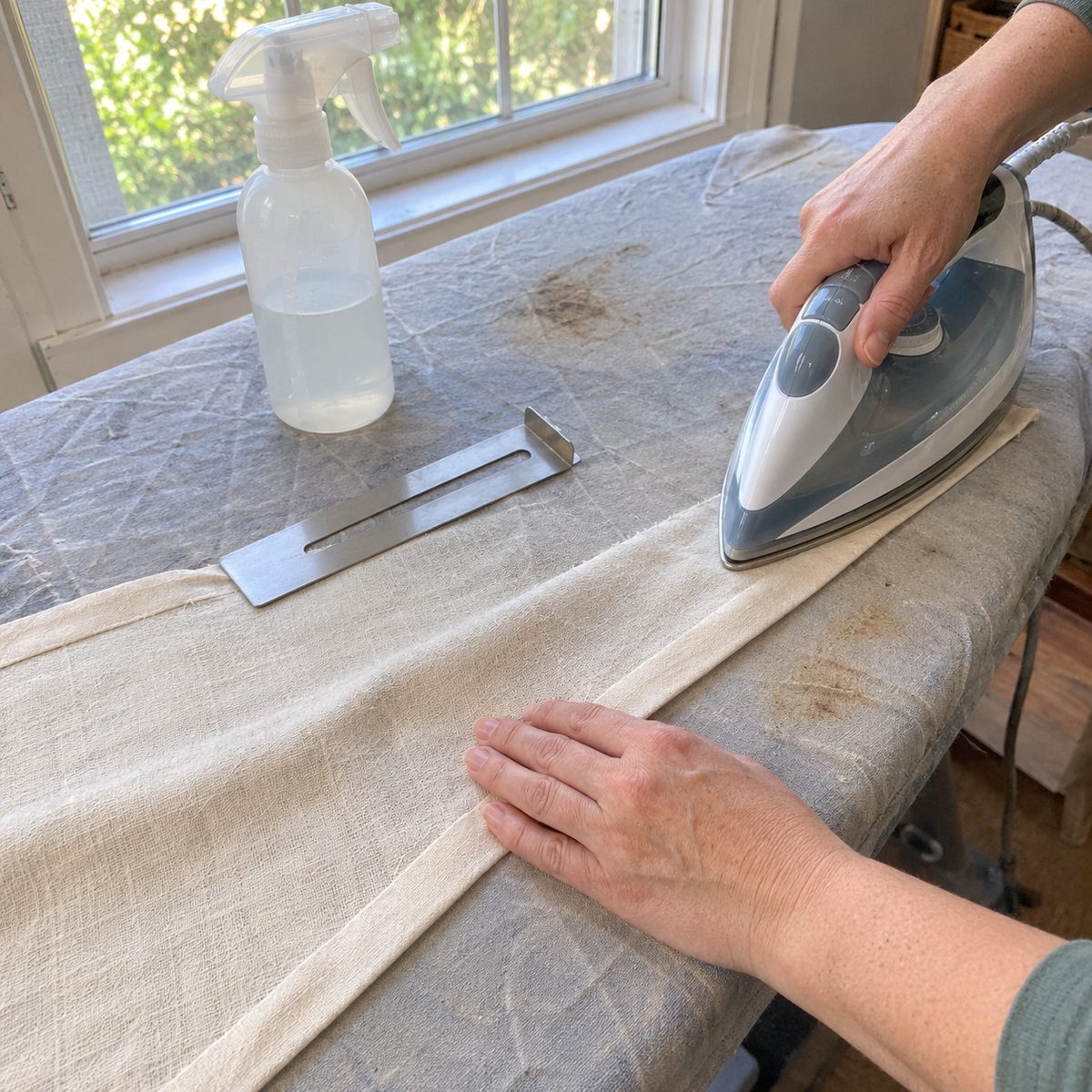
- Lay the towel wrong side up. Fold one long edge over 1/2 inch and press, checking with the hem gauge every 6 inches. Spritz the fold first. Linen only holds a crease if it is damp when it meets the iron.
- Fold that edge over another 1/2 inch so the raw edge is enclosed, and press again. Repeat on the opposite long side.
- Do the two short ends the same way. At each corner the short-end hem now sits on top of the long-side hem, four layers deep. That lump is what the next phase removes.
- Open all four hems back out flat. You should see two crease lines parallel to every edge, one 1/2 inch in and one 1 inch in.
Miter the corners so they lie flat
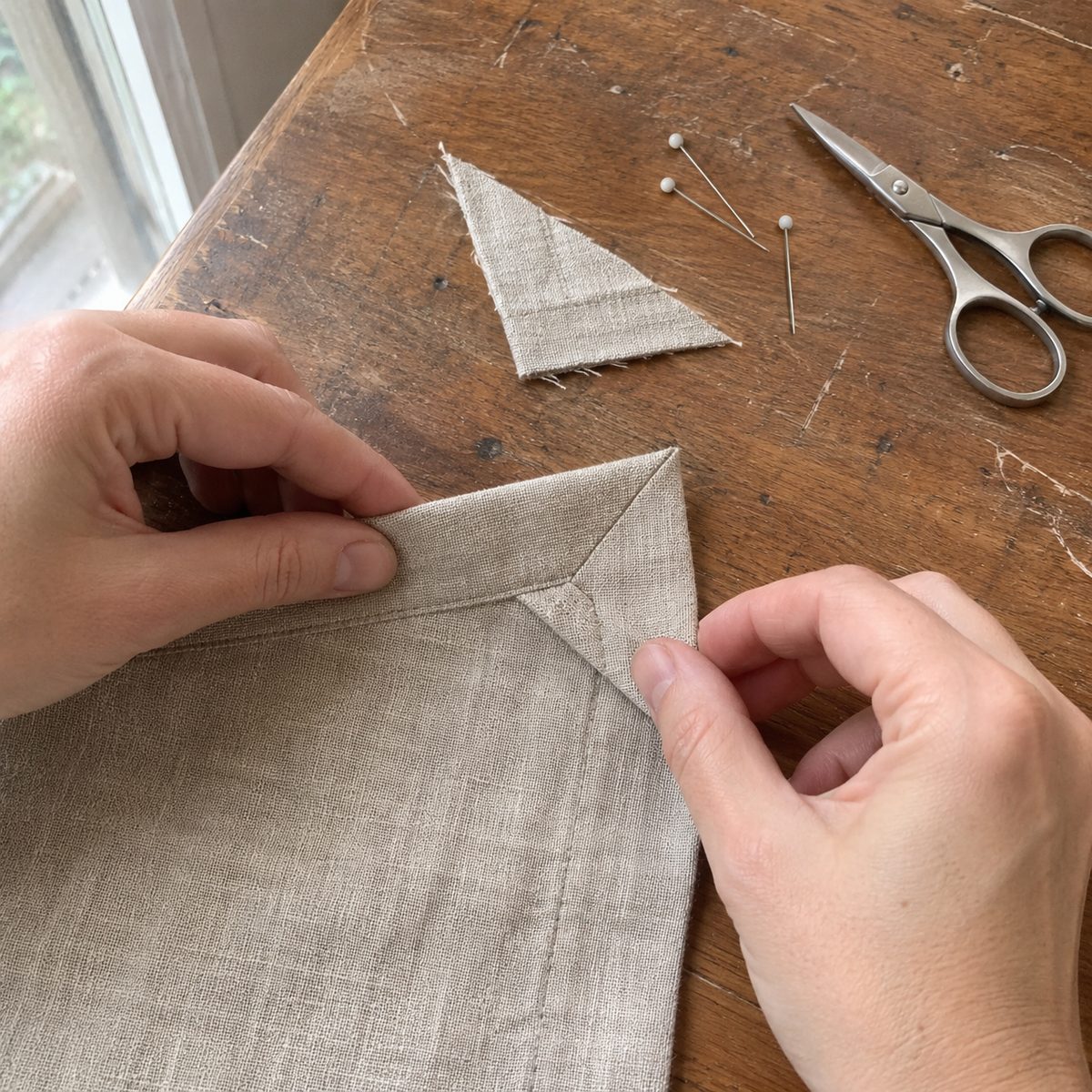
A miter folds the corner bulk away on the diagonal so the two hems meet at a 45 degree line instead of stacking.
- With the hems open, find the point at one corner where the two inner crease lines, the ones 1 inch from the edges, cross. Fold the corner in diagonally, wrong sides together, so the fold passes exactly through that point and the raw edges line up. Press the diagonal crease hard.
- Unfold and trim the corner off 1/4 inch beyond the diagonal crease, toward the point. Do not cut on the crease. That 1/4 inch is the miter’s seam allowance, and without it the raw corner shows through.
- Refold the corner on the diagonal crease, then refold the first 1/2 inch hem on both sides. The folded edges meet in a straight diagonal line from the point in toward the towel.
- Refold the second 1/2 inch hem on both sides. The two hem edges should butt along the diagonal with no gap and no overlap, and the point should be sharp. A gap means the fold missed the crossing point, an overlap means you trimmed too little. Pin or clip it.
- Do the other three corners. All four should match, and the towel should lie dead flat with nothing lifting.
Stitch the hems and corners
- Set a 2.8 mm straight stitch for flour sack or blends, 3.0 mm for linen and huck. Shorter stitches pucker thin cotton. Test on a folded scrap three layers thick until the stitch looks the same from both sides.
- Start in the middle of one long side, never at a corner, hem facing up. Sew along the inner folded edge of the hem, about 1/16 inch from the fold.
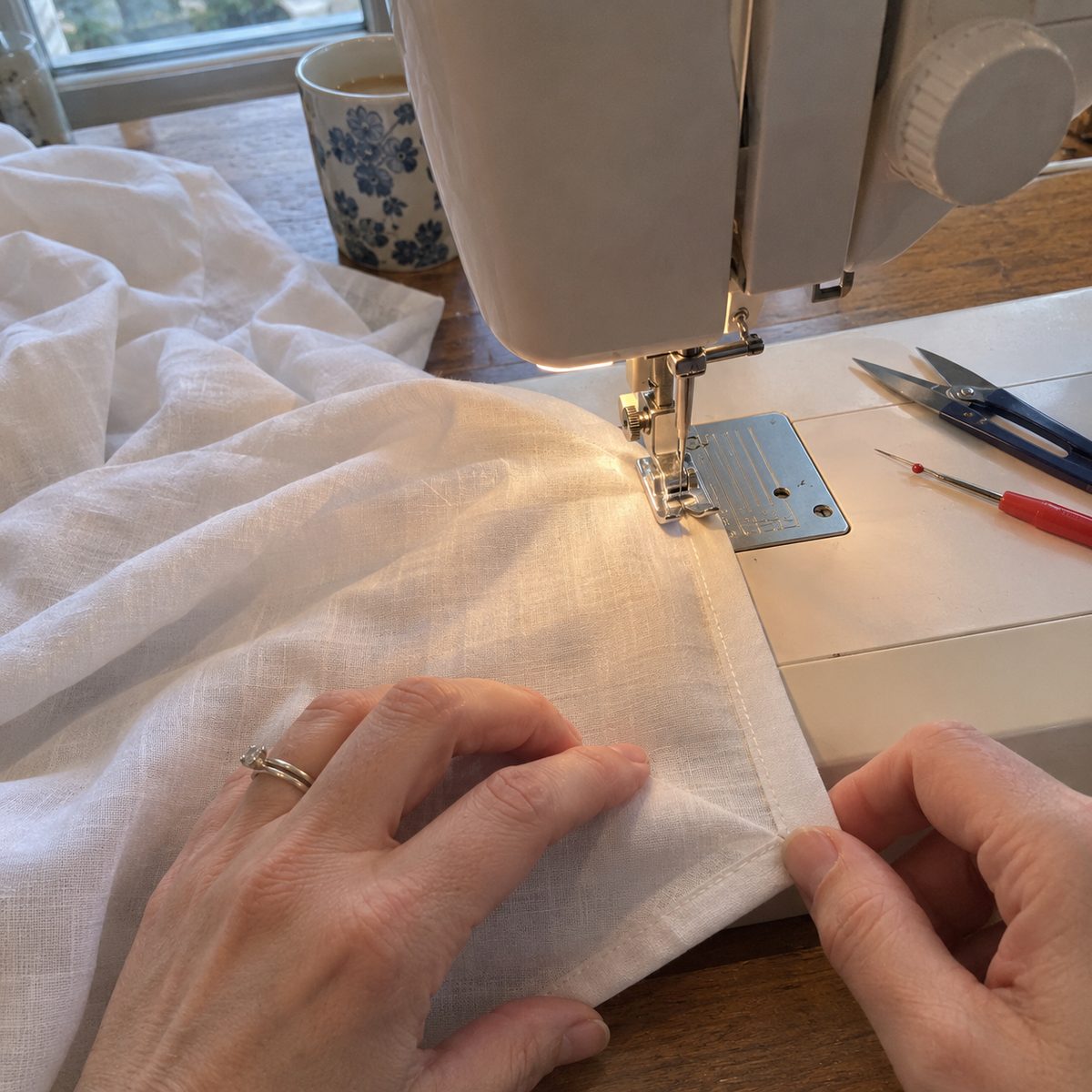
- Stop with the needle down about 1/16 inch before the miter line, lift the foot, pivot 90 degrees, and keep going. The stitching should turn a clean square corner with the miter folds caught underneath. You do not need to sew the miter closed. The pivot stitch holds it.
- Go around all four sides, overlap your starting stitches by 1/2 inch, clip threads, and press from the right side with steam. The hem should be flat and 1/2 inch wide all around, with one unbroken line of stitching.
Add the fabric band across one end
A rippled band looks worse than no band at all. These steps keep it flat.
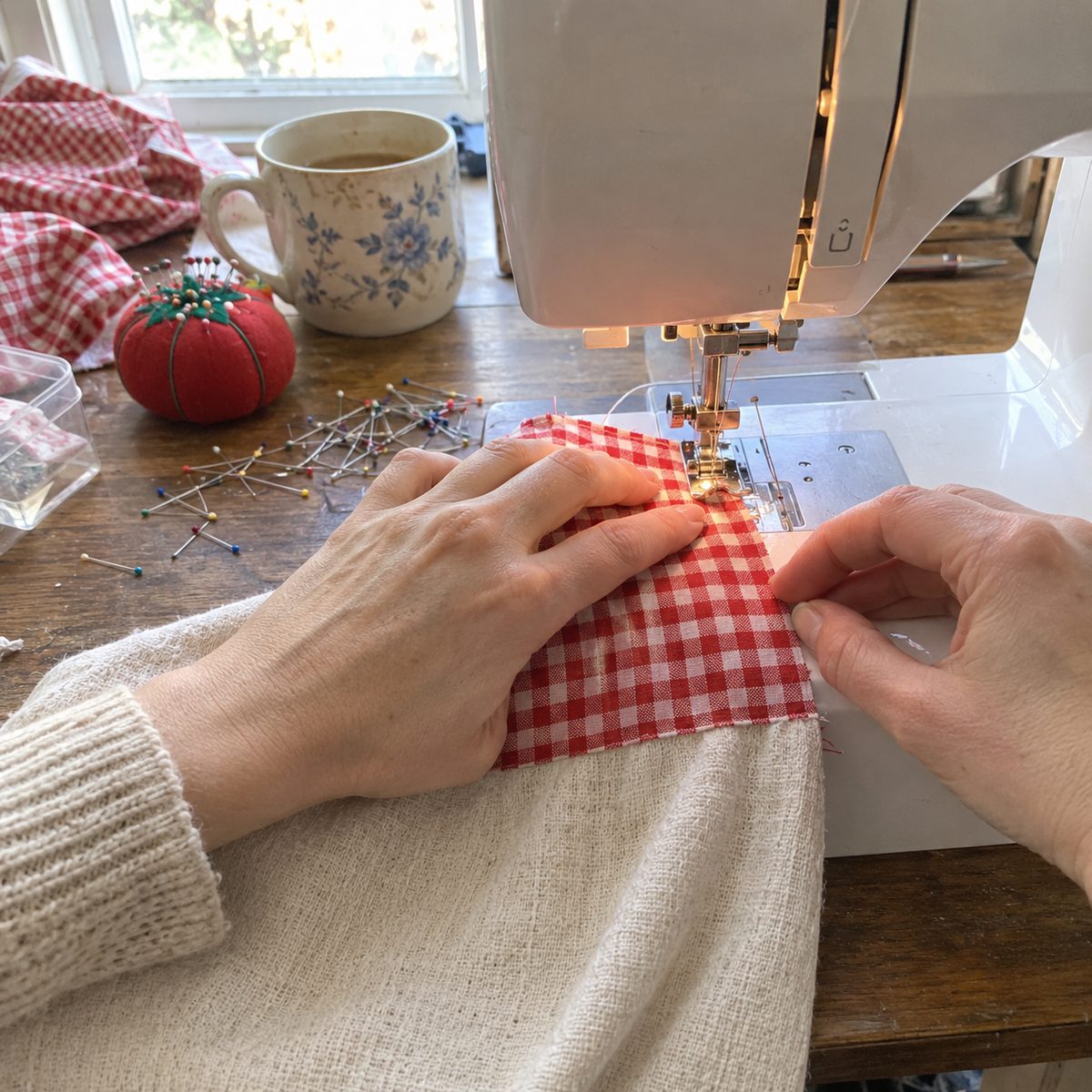
- Press the band’s two long edges under 1/2 inch to the wrong side, then both short ends under 1/2 inch. It is now 3 1/2 inches wide and exactly the width of the towel. Lay it right side up on the towel, lower edge 2 inches above the bottom hem, ends flush with the side hems. Pin every 2 inches.
- Edgestitch the lower edge first, 1/8 inch from the fold, from the left side hem to the right. Go back to the left and sew the upper edge in the same direction. Sewing both edges the same way is what stops ripples. Sew one down and the other back and the band drags into a slant.
- Edgestitch the two short ends through the side hems. Keep the fabric lightly taut with one hand in front of the foot and one behind, without pulling. A walking foot helps on linen.
- Press the band from the right side. It should lie smooth with no bubbling between the two stitching lines, and the towel under it should lie flat too.
Make and attach the hanging loop
- Fold the 2 by 6 inch strip in half lengthwise and press. Open it, fold the raw long edges in to the center crease, press, fold on the center crease again, and edgestitch both long edges. Twill tape skips all of this.
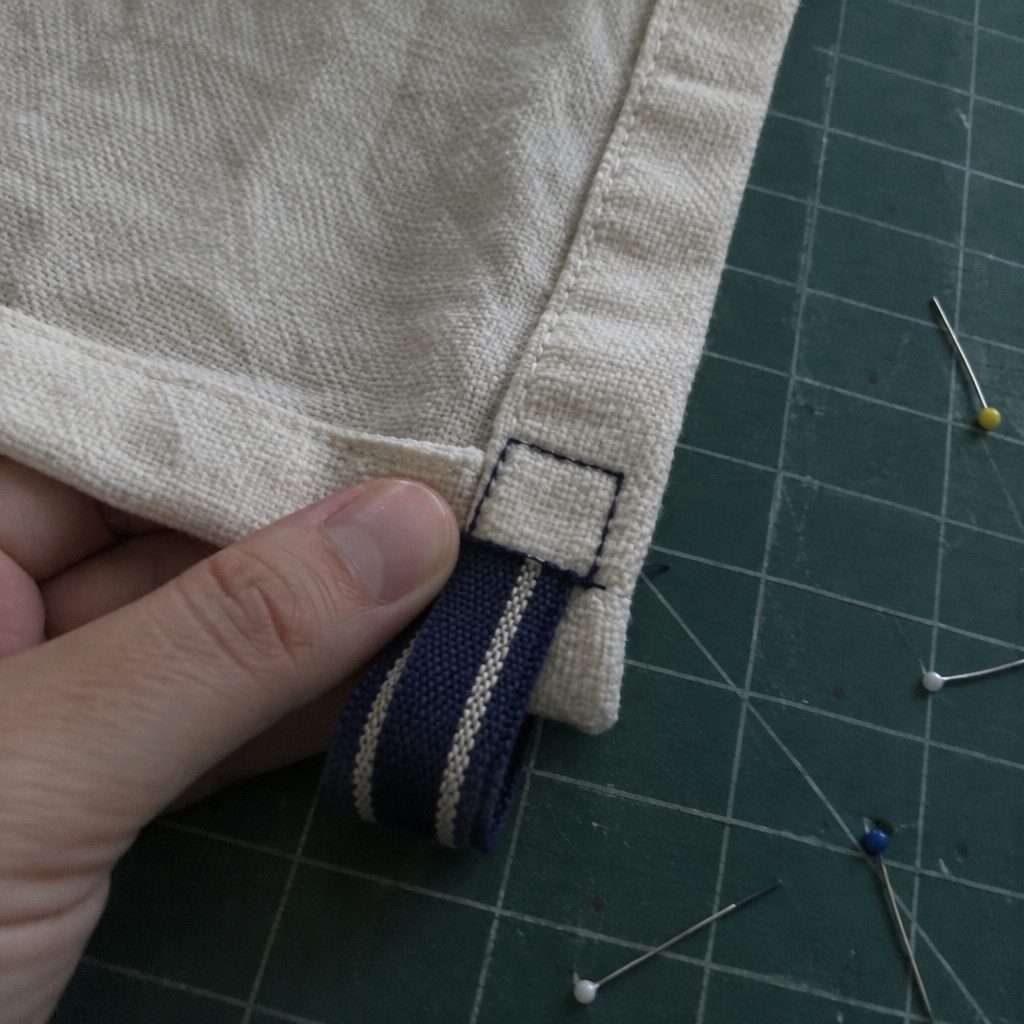
- Fold the strap in half to make a loop. The usual spot is one top corner, poking out at a 45 degree angle from the miter. Tuck the raw ends 1/2 inch under the hem at that corner, from the wrong side.
- Stitch a 1/2 inch box over the hem where the ends sit, going around twice. To hang it from the band end instead, tuck the ends under the band’s upper edge before stitching it. The loop should take a hard tug without a stitch moving.
- Give the towel a last press with steam and trim thread tails. The first one is about 40 minutes. By the sixth it is closer to 20.
Fixes for the things that go wrong
The hem ripples along the long sides
The stitch was too short, the fabric was pushed into the foot, or the piece was off grain so the hem is partly on the bias. For the first two, lengthen to 3.0 mm, let your hands guide instead of push, and press hard with steam. A hem on a crooked piece stays crooked.
The corner is bulky or the miter gaps
A lump means the corner was trimmed too little, or not at all. Open it, trim to 1/4 inch past the diagonal crease, and refold. A gap means the two hems were pressed at different widths. Repress the narrow one and fold again.
The band puckers between the stitching lines
Either the band and towel shrank differently, or the two edges were sewn in opposite directions. Before washing, unpick the upper edge and resew it in the same direction as the lower one. After washing, the band was not prewashed. Cut it off just above the stitching and sew on a new one.
The towel is not square after washing
It was cut off grain, and the wash let the threads settle where they wanted to be. Nothing fixes a finished towel, but it still dries dishes. Next time tear the pieces and press each one square before hemming.
Variations, gift sets, and batch making
A bar mop towel at 16 by 24 inches cuts at 18 by 26. A bread towel at 22 by 28 cuts at 24 by 30, best in linen with no band.
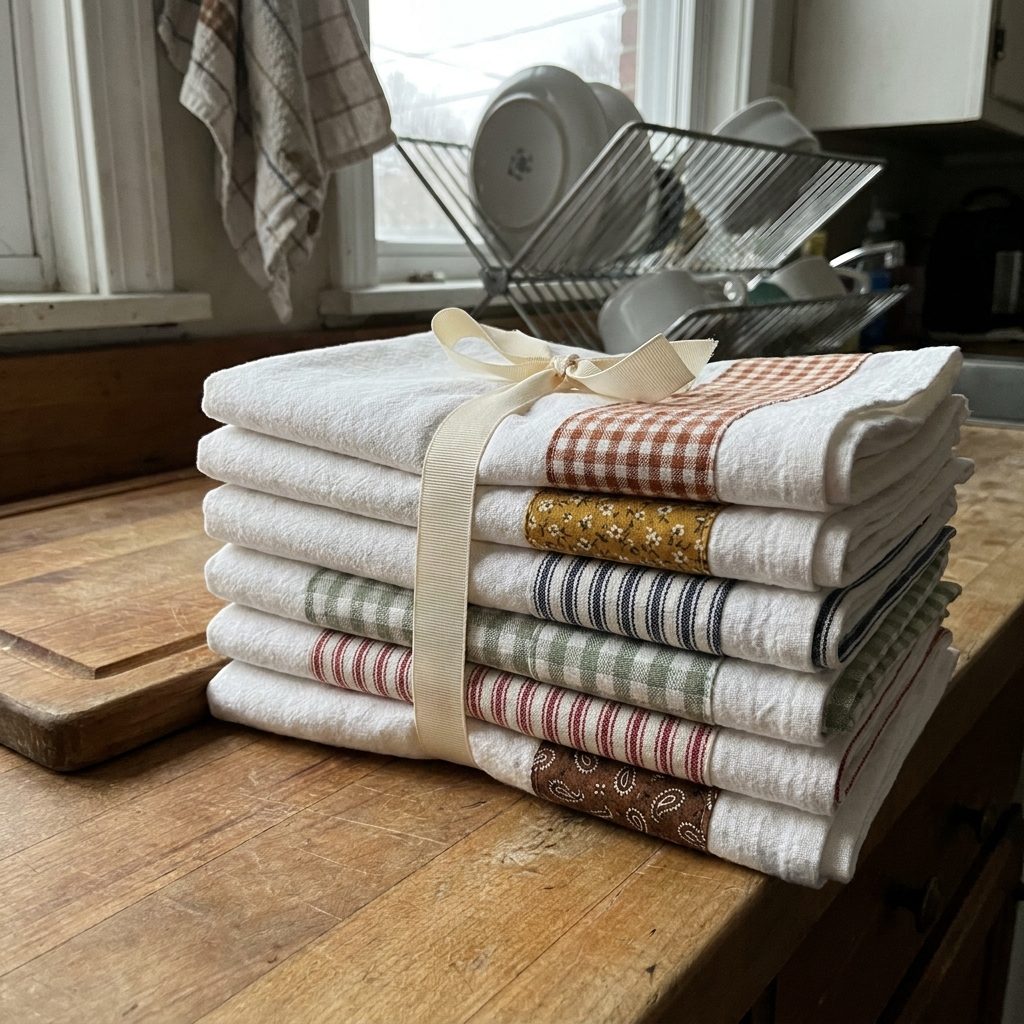
The band is where the season lives. Gingham for summer, a small rust check for fall, red and green ticking for December. I keep the body plain, white or natural, and let the band be the only print, because two prints on one towel fight with the kitchen. For a wedding, embroider initials on the band while it is still flat.
A set of three with matching bands, folded bands out and tied with grosgrain ribbon, is one of the easier handmade gifts to sew, and it reads as something from a shop. If the same person is getting an apron, use the band print for the pocket.
For six, work in stages. Tear and press all six bodies in one sitting, about 45 minutes. Press all 24 hems and miter all 24 corners the next evening, about an hour. Stitch all six hems in one run, about 50 minutes. Bands and loops last. Around three hours total, and the leftover band strips feed half the kitchen sewing projects list.
Frequently asked questions
What is the best fabric for sewing tea towels?
Linen if you can afford it, flour sack cotton if you cannot, and a cotton-linen blend if you want less wrinkling. All three are absorbent plain weaves that hem flat. Huck is the one for scrubbing pans. Skip terry cloth and quilting cotton for the body.
Do I really have to prewash the fabric?
Yes, hot wash and hot dry, before you cut. Flour sack cotton can lose 2 inches of length on its first wash, and if that happens after hemming, the hems twist and the band puckers. Prewash the band fabric the same way.
How wide should the hem on a tea towel be?
A 1/2 inch double-fold hem is right for flour sack cotton, linen, and blends. Drop to 3/8 inch on very thin cotton and go up to 5/8 inch on huck. Wider than 3/4 inch starts to look like a napkin.
Can I serge the edges instead of hemming?
You can, and it takes 2 minutes a towel. The edge looks like a shop rag and wears through at the corners long before a hem does. Hem the towels you will give away and serge your own scrub towels. My serger versus sewing machine post has more.
Make one towel start to finish before you cut a set, so your first four corners happen on a towel nobody else will see. After that the pressing goes fast and the stitching is a straight line. Six on a shelf, folded with the bands out, looks like you knew what you were doing all along.